Stay on Schedule: Using Mobile Surveillance to Track Property Renovation Projects
Discover how mobile surveillance can improve visibility across property renovations, helping teams monitor site activity, identify disruptions, and stay on schedule.

Commercial property renovations depend on trades working in a set order. Electricians can't start until strip-out is complete, and drywall can't go up until electrics pass inspection. So, when copper wiring disappears from a partly finished building overnight, that sequence stops while materials are reordered and crews are rescheduled.
This is where using mobile surveillance to track property renovation projects can help investment teams manage that risk. Surveillance units can be operational within minutes of arriving on-site, move between areas as each phase changes the site layout, record incidents as video evidence, and stay for the length of the project on a rental basis without the cost of a permanent installation.
Schedule pressure is already a familiar problem in the construction industry. In AGC's 2026 Construction Hiring and Business Outlook, over 63% of contractors said a project had been postponed, scaled back, or canceled within the past 6 months.
On a value-add renovation, every week the schedule slips adds holding costs and pushes back the rental income the business plan depends on, so security incidents that delay contractors carry a cost well beyond the site itself. In this article, we cover why renovation sites lose momentum and how mobile surveillance helps keep each phase on schedule, from strip-out through to handover.
4 Reasons Property Renovation Sites Lose Momentum
Security incidents slow a project down when they interrupt the order that trades work in, and commercial renovations carry specific security challenges that make those incidents more likely. A building under renovation is often partly open and vacant, with materials stored on-site waiting to be installed.
1. Valuable materials sit on-site before installation
Renovation projects bring valuable materials onto a property weeks before they're installed, and much of that stock is easy to remove and resell. Copper wiring, HVAC units, plumbing fixtures, and power tools are frequent targets, which makes copper theft a recurring risk on commercial renovation sites.
Because copper and HVAC components go in early in the build, losing them holds up the electrical and mechanical work that the rest of the project depends on.
Discover the Top 10 Commercial Property Hotspots for Copper Theft
2. Changing site layouts leave blind spots
Site layouts constantly change during renovations and redevelopment, as temporary fencing moves, scaffolding goes up, dumpsters are swapped, and new openings appear in the building shell.
Each change can create an unmonitored entry point, and trespassing through those gaps can lead to theft, damage, fire risk, or unauthorized occupancy of empty floors. Anyone injured on an unsecured site can also expose the owner to a premises liability claim.
3. Quiet periods between trades invite crime
Activity on-site stops after working hours, and again during gaps between trades when one contractor has finished, and the next hasn't arrived. Without a human presence on-site during those periods, criminals have time to strip materials or use the property for illegal dumping.
Vandalism to finished areas is particularly costly because damaged drywall, fixtures, flooring, and glazing have to be repaired before the next trade can continue or the space can be shown to prospective tenants.
4. One incident delays every trade that follows
A single theft or break-in rarely affects only one trade. After an incident, project managers have to secure the site, file police reports and insurance claims, reorder materials, and reschedule crews, and some contractors won't remobilize until the site is safe.
Any inspection booked for the affected work slips as well, pushing completion and lease-up dates further out. For the investment team, that shows up as unbudgeted expense and slower stabilization, both of which put pressure on internal rate of return (IRR). Repeat incidents can also bring closer insurance scrutiny and higher premiums at renewal.
Read more:
- How Theft Disrupts Construction Timelines in Value-Add Properties
- Preventing Repeated Equipment Theft at Commercial Renovation Sites
- Understanding Insurance Requirements for Different Property Types
Where Traditional Security Falls Short on Renovation Sites
Traditional security measures still have a place on renovation sites, but security guards and fixed systems have limitations and often struggle as a project changes.
Guards provide a human presence and can respond in person, but they need to be "in the right place at the right time". On-site surveillance is also priced by the hour, so 24/7 coverage across a long renovation (or portfolio) adds up quickly.
Fixed camera systems on a permanent installation also have limitations. Not only do they require fixed power and Wi-Fi, but they also stay where they're mounted while the areas that need coverage move as site layouts change.
Mobile security units close both gaps, because a single trailer covers a wide area continuously, deters intruders with lights and sirens, records every alert in the cloud, and can be repositioned in minutes when the site changes. That makes mobile surveillance a practical foundation for any jobsite security, with guards and fixed cameras added where a project needs them.
Read more:
- Mobile Surveillance vs Fixed Install Systems for Commercial Construction
- Comparing LotGuard to Alternative Surveillance Options for Vacant Listings
How Mobile Surveillance Keeps Renovation Projects on Schedule
Mobile surveillance cameras keep renovation projects on schedule by stopping incidents before they reach the work and by giving project teams a clear record of what happened on-site. The key features below cover how mobile surveillance protects stored materials, follows changing site layouts, gives stakeholders remote visibility, and records the evidence needed after an incident.
Immediate protection from day one
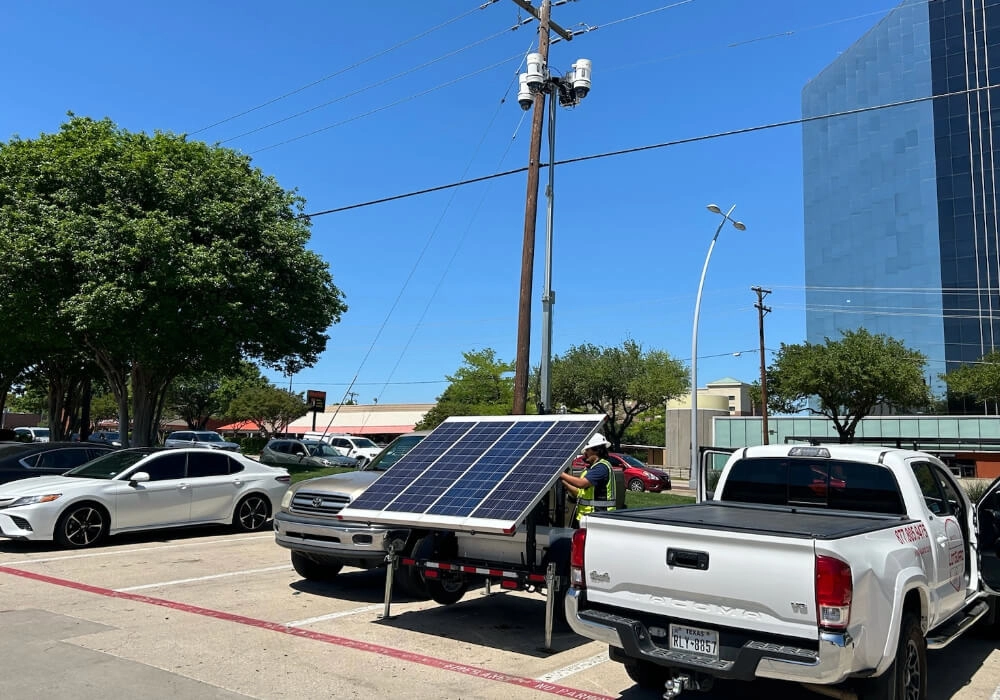
Mobile surveillance trailers can protect a property renovation site before work begins, because they don't need trenching, cabling, site power, or an internet connection to operate. The LotGuard PRO, for example, stands up to 20-feet tall on a telescopic mast, with near-360° coverage from fixed and PTZ (Pan-Tilt-Zoom) cameras.
It runs on solar energy with battery backup and transmits live video over secure 5G networks, which suits remote locations and vacant buildings where utilities are shut off during renovation or not yet available. Once delivered, a unit is operational in minutes (basic setups), making rapid deployment possible straight after closing, before the first contractor even arrives on-site.
Fixed systems take longer to set up because a permanent installation depends on site power and network cabling. On a renovation, those security cameras are also mounted on a structure that's about to change, so coverage can be lost as walls come down and layouts change. Mobile security units avoid that problem, making them well suited to construction site security on temporary project developments.
Proactive security that stops incidents before they escalate
Stopping an intruder at the perimeter costs far less time than replacing stolen copper and remobilizing a crew, which is why LotGuard PRO trailers carry active deterrents, making it clear the site is being watched.
Built-in AI detection identifies people and vehicles in high-risk areas, filters out harmless movement caused by weather or debris, and sends alerts as soon as suspect activity is detected.
With Live Video Monitoring, those alerts go to trained operators at an Alarm Receiving Center (ARC), who verify each threat in real-time. From here, operators can issue live audio warnings, activate lights and sirens, escalate verified incidents to site contacts or law enforcement, and record the events until help arrives. These remote monitoring capabilities mean problems are dealt with near-instantly rather than discovered by crews the next morning.
Read more:
- Benefits of Remote Video Monitoring for Surveillance Cameras
- ROI Calculator: Preventing Copper Theft in Commercial Property Renovations
Coverage that moves with each renovation phase
Mobile units can be repositioned as renovation work moves across the property, so a trailer that guards the perimeter during strip-out can move to material storage and loading docks once rough-in begins. Trailers can also be easily added across multiple sites to increase security as portfolios grow.
Because most units are rented rather than purchased, coverage lasts as long as the renovation does and can be scaled up or down as areas are finished and secured. Our fully-managed service covers delivery, installation, connectivity, remote diagnostics, and maintenance for the length of the deployment, so site teams don't have to manage the equipment between phases.
Remote visibility and progress documentation
Remote access through our cloud-based platform lets project managers, asset managers, owners, and other stakeholders view live and recorded footage from any connected device. This remote visibility reduces the site visits needed to check on progress, which matters for investment teams overseeing renovations at several properties at once.
Our cloud-based platform also brings footage from every unit into one place, with smart search filters that make it easy to find specific activity, such as when a delivery arrived or when crews clocked off for the day. Users can generate reports to share with stakeholders, allowing teams to quickly confirm milestones and spot work that has fallen behind.
Read more:
- Centralizing Risk Reporting Across Multi-Site Property Portfolios
- 9 Benefits of All-in-One Surveillance Platforms for Commercial Real Estate Investors
Vehicle records at site entrances
Contractors, suppliers, and inspectors drive in and out throughout the day, making it hard to know who has been on-site and when. Add-on License Plate Recognition (LPR) technology to a deployment captures each vehicle's plate number, as well as its make, model, color, and speed as it enters or leaves.
Each reading is timestamped and linked to video footage, so project teams can check which vehicles were on-site when materials went missing and identify repeat visitors outside working hours. That record helps support access control on sites where gates and fencing change throughout the project.
Read more:
- Implementing License Plate Recognition Across Multi-Site Commercial Portfolios
- Using LPR to Track Suspicious Vehicles at Vacant Property Listings
Video evidence for insurance claims and contractor disputes
Recorded footage gives investment teams timestamped video evidence of each incident and how it was handled. Through our cloud platform, site footage can be exported for law enforcement and insurers, giving both clear evidence and reducing the chance of a disputed claim.
The same footage helps settle disputes on the jobsite over damage to completed work or whether a task was finished on a given date, giving project managers and contractors a shared reference point instead of competing accounts. Investment managers can also use those records in lender updates and investor reports to show that site risk is being actively managed.
Read more:
- How Video Documentation Supports Insurance Claims in Commercial Properties
- How LotGuard Protects Investor Reporting Across Commercial Property Portfolios
Matching Mobile Surveillance Coverage to Each Renovation Phase
Each renovation phase changes what's on-site and where the risk sits, so coverage works best when it's planned phase by phase.
This table maps each phase to its main exposure and the steps that help keep work on schedule:
|
Phase |
Main exposure |
How to keep work on schedule |
|
Strip-out and demolition |
Open building shell and scrap metal |
Secure the perimeter and deter after-hours entry |
|
Electrical and mechanical rough-in |
Copper wiring and HVAC units in storage |
Protect storage areas and log vehicles at entrances/exits |
|
Fit-out and finishes |
Delivered fixtures and completed work |
Verify alerts as they happen and record any damage |
|
Handover and lease-up |
Vacant units and after-hours activity |
Monitor entrances and review long-term security needs |
Planning coverage ahead of each phase keeps protection in place when the work moves. The rough-in setup can be scoped during strip-out, and the fit-out setup while rough-in is underway, so units are already in position when valuable materials arrive.
At handover, once utilities are connected and the layout is final, a permanent installation may make sense for the long term. Mobile units can move to the next renovation in the portfolio or to high-risk site areas such as parking areas and entrances to maintain 24/7 coverage even after the renovation is complete.
Read more:
- Protecting Vacant Units and Fixtures During the Lease-Up Phase
- How to Manage Multiple Property Renovations Remotely
Keep Property Renovation Projects on Track
Renovation schedules depend on each trade finishing on time so the next one can start, and a single incident can break that sequence chain. Theft or damage costs far more than the replacement value, because it delays inspections and lease-up, which postpones the net operating income (NOI) the property was bought to produce.
Mobile surveillance gives commercial real estate investment teams control over that risk across the entire property, with protection that arrives quickly, helps deter theft 24/7, moves with each phase, and leaves a record every stakeholder can review.
With systems that are "Always Awake and Always on Guard", property investment and management teams can keep renovations moving from day one.

Contents
[hide]Related news
Preventing Repeated Equipment Theft at Commercial Renovation Sites
Learn how to prevent repeated equipment theft at commercial renovation sites by identifying security gaps and strengthening monitoring and site protection. Read more
Understanding Insurance Requirements for Different Property Types
Learn how insurance requirements vary across commercial property types and what owners need to manage risk and stay protected. Read more
ROI Calculator: Preventing Copper Theft in Commercial Property Renovations
Calculate the potential cost of copper theft during commercial property renovations and compare losses against the investment in proactive site security. Read more
FAQs
Where should cameras be placed to avoid privacy issues with neighboring properties?
Cameras on a renovation site should face the work areas, perimeter, entrances, and material storage, rather than neighboring windows or yards.
The Reporters Committee for Freedom of the Press explains that consent requirements generally apply where people have a reasonable expectation of privacy, so coverage that drifts onto adjacent properties can cause problems even when recording the site itself is lawful. Agreeing on camera positions before deployment and checking local rules with legal counsel helps avoid complaints.
How long should mobile surveillance stay on a renovation site?
Coverage works best when it starts before the first contractor mobilizes and continues until the property is handed over or leased. Renovation sites stay exposed between phases and during any pause in work, so removing units early can leave valuable materials and completed areas unprotected.
Contact Us
Request a Quote for LotGuard
Ready to learn more about how LotGuard can protect your Parking Lots and Properties? Get in touch today for a free quote.