
Mobile Surveillance vs Fixed Install Systems for Commercial Property Construction
Compare mobile surveillance and fixed security systems for commercial property construction, including flexibility, cost, coverage, and deployment.
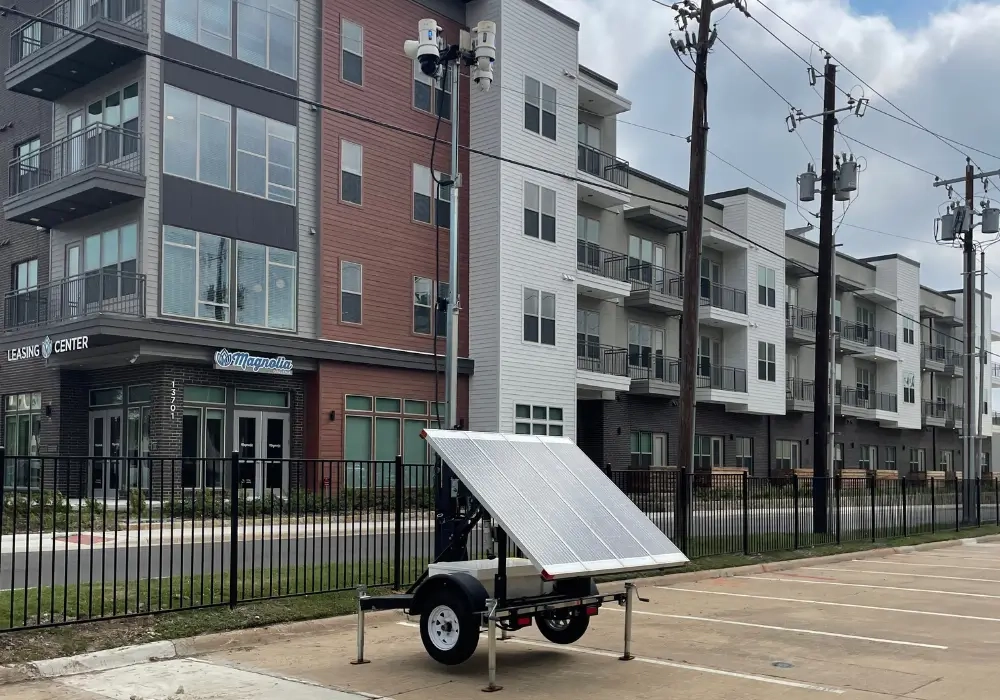
Construction site theft costs the U.S. industry between $300 million and $1 billion annually, according to estimates from the National Equipment Register and National Insurance Crime Bureau. For commercial property redevelopment specifically, security risks can arise as soon as a property changes hands, often before construction begins.
Vacant properties and active redevelopment sites can be vulnerable to copper theft, late-night trespassing, arson, illegal dumping, and squatting. With fewer people on-site and limited supervision, these properties can become easier targets for both opportunistic thieves and organized crime groups. And that's where the majority of problems start.
As redevelopment progresses, site conditions and security needs change, too. Access points shift, new areas become vulnerable, and equipment and materials move around the site. The security setup that works immediately after acquisition may no longer suit projects moving towards completion and stabilization, so managers need to reassess coverage and adjust security as the site evolves.
But for commercial real estate (CRE) investment managers, this creates a practical challenge: how do you secure a site from day one while keeping surveillance flexible enough to adapt as work progresses, without committing to permanent infrastructure?
Below, we compare mobile surveillance units with fixed security camera systems on what matters for property redevelopment and repositioning projects. We'll look at how each system is installed, the benefits and limitations of each, and how LotGuard helps protect assets, people, and property throughout the transitional phase.
Mobile Surveillance Systems vs. Fixed Install Systems for Construction Sites
Here's a quick overview of how mobile surveillance and fixed systems measure up:
|
Feature |
Mobile |
Fixed |
|
Deployment time |
Hours with minimal setup |
Days to weeks with complex installation |
|
Infrastructure |
No fixed power or Wi-Fi; generally runs on solar power and battery backup |
Requires local power and involves extensive trenching |
|
Flexibility |
Yes, easy to relocate and reposition |
No, fixed in place |
|
Coverage time |
Immediately after deployment |
Delayed until installation is complete |
|
Scalability |
Yes; add, remove, or relocate units as risk zones shift |
Limited; new installation work is required |
|
Cost |
Hired model |
High upfront capital investment |
|
Best suited to: |
Sites with changing layouts and those without fixed infrastructure |
Sites where risks are more permanent, and where local power/Wi-Fi is already in place |
Read more:
- Enhancing Perimeter Control at Commercial Property and Construction Sites
- 7 Key Risk Factors to Monitor in Transitional Commercial Properties
- Commonly Asked Security Questions From Property Managers
- Short-Term Security Rentals vs Long Contracts for Real Estate
Mobile Surveillance Systems: Explained
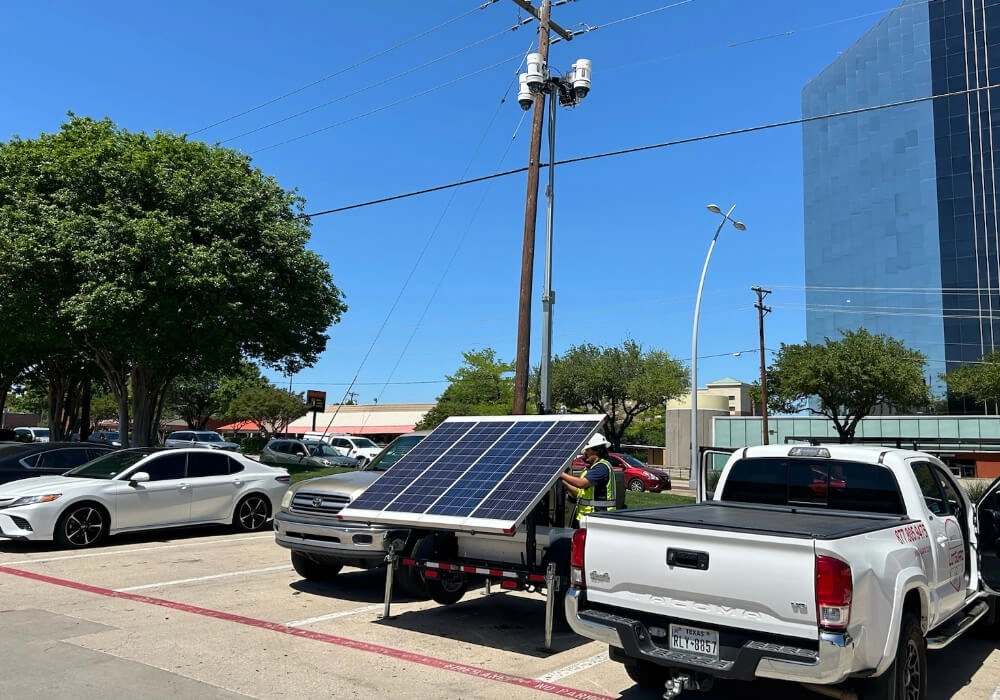
Mobile surveillance systems are self-contained units, typically solar-powered with battery backup. This means they operate without a fixed internet connection or existing infrastructure, making them ideal for sites where utilities aren't yet connected or in off-grid locations.
Deployment speed, camera coverage, and features
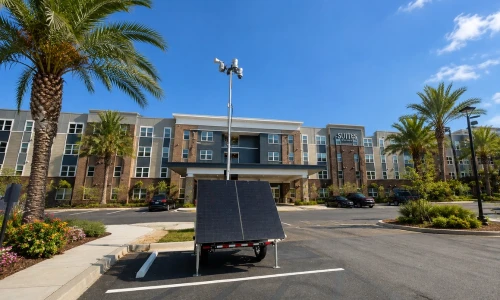
Mobile surveillance units, like the LotGuard PRO, can be deployed within hours, with basic setups operational in around 20-minutes. Our plug-and-play mobile surveillance trailers run on solar energy and batteries, so there's no dependency on local power or extensive trenching. This allows investment managers to secure a property soon after acquisition, then relocate or reposition units as site conditions and security risks change. Teams can also move units themselves when coverage needs shift.
Fully-managed trailers are equipped with wide-angle mobile surveillance cameras that provide near-360° coverage, helping teams monitor large areas with fewer blind spots. AI-video analytics and smart detection identify suspicious behavior as it unfolds and can even monitor activity in low-light or adverse weather conditions, while filtering false alarms. Sites monitored with our mobile surveillance solutions have reported up to an 87% reduction in crime.
With 24/7 live video monitoring, property management teams can maintain oversight of their sites across vacancy, redevelopment, and repositioning, even when nobody is physically present. Trained operators at an Interactive Surveillance Operations Center (ISOC) verify potential threats and trigger rapid responses on your behalf, such as dispatching police. This can significantly reduce manual spot checks and the need for multiple vendors.
Site data is transmitted over secure 5G networks, with incidents timestamped and logged in our cloud-based monitoring platform. This gives investment managers a single view of everything that happens on site and a clear audit trail, with the ability to generate reports on demand. These reports can be used to keep [investors] informed and provide evidence for insurance claims and law enforcement investigations.
On top of all this, mobile systems also support various add-on integrations, like License Plate Recognition (LPR) technology, which can help identify and track vehicles entering or leaving a site. This is particularly useful in high-risk environments where on-site supervision is limited after hours.
Benefits of mobile surveillance systems
- Rapid deployment for near-instant coverage, even in remote locations
- Operates independently of local power and network connections
- Reduces reliance on on-site guards
- Real-time monitoring enables faster response and decision-making
- Wide-coverage cameras with a near-360° field of view to reduce blind spots
- Mobile surveillance systems can be easily repositioned/relocated as site conditions evolve
- Includes 24/7 remote monitoring, reducing physical manual checks
- AI threat detection prioritizes real threats (theft, vandalism, illegal dumping, etc.) over false alarms
- Centralized cloud platform with clear visibility across multiple sites
- Cost-effective surveillance; flexible rental packages (within a fully-managed service)
Limitations during redevelopment
- Solar and battery systems may drain faster depending on the manufacturer/supplier
- Surveillance trailers take up physical space (i.e., bigger footprint)
- Improper positioning if not backed by professional support
- May not be aesthetically pleasing
Best suited to:
- Newly acquired properties (including vacant sites)
- Active construction sites and repositioning projects
- Industrial and commercial properties
- Value-add and Real Estate Owned (REO) redevelopments
- Industries: Temporary projects, construction, retail centers, offices, parking lots
Fixed Security Systems: Explained
Fixed security systems are more traditional security measures, with cameras and motion sensors permanently wired to a property's power supply and existing infrastructure. This approach is built to stay exactly where it's installed, but doesn't offer much value to sites with changing environments.
Installation, camera coverage, and features
Installing a fixed surveillance system can take days or weeks, depending on the site's size and the amount of cabling and trenching required. These systems typically rely on the property's electrical supply and network infrastructure, which can complicate installation. Unlike solar-powered mobile units, they generally aren't designed for off-grid operation and may lose functionality during power outages unless backup power is available.
Fixed cameras also only cover the areas where they're installed, whether that's on walls, poles, or dedicated mounting structures. This can be a limitation as redevelopment progresses and site layouts change. For example, cameras positioned to monitor a property immediately after acquisition may no longer provide adequate coverage once renovation work begins, leaving new access points or work areas exposed unless the system is adjusted (which can be costly).
Most fixed systems use high-definition cameras, with some offering features such as thermal imaging for nighttime surveillance. However, recording and monitoring capabilities vary. Basic systems may simply record footage for later review, offering limited real-time deterrence. More advanced setups can include remote monitoring and alerts, allowing managers to respond to suspicious activity as it happens. Even then, effective monitoring depends on camera placement, detection capabilities, and whether someone is actively reviewing alerts or footage.
Fixed camera systems can be a practical choice for fixed redevelopment projects or stabilized commercial properties, where security needs and site layouts are relatively consistent. However, the installation costs and infrastructure involved can be harder to justify for temporary projects or properties requiring frequent coverage adjustments. Expanding a fixed system across multiple locations can also mean repeating much of that installation work at each site, which comes with high security costs.
Benefits of fixed security systems
- More cost-effective for permanent, commercial property requirements
- Can integrate with existing security and building management systems
- No recurring rentals or subscriptions
- Reliable coverage for redevelopment site with fixed placements
Limitations during redevelopment
- Installation is lengthy, taking days to weeks with extensive cabling and trenching
- Leaves coverage gaps for sites with changing environments
- Unable to reposition once fixed in place
- Scalability is expensive, requiring additional hardware and cabling
- Video surveillance captures incidents after the fact
- Some systems provide "record-only" functionality
- Not suited to temporary projects or construction sites
Best suited to:
- Sites with no planned layout changes
- Premises with permanent infrastructure (mains power, Wi-Fi, etc.) already in place
- Long-term, permanent commercial operations once a property reaches stabilization
Mobile vs. Fixed Security: 5 Factors to Consider
Below, we take a quick look at 5 factors worth considering when comparing mobile and fixed surveillance systems:
1. Deployment speed and immediate site protection
The window between acquiring a property and having security in place is where most preventable loss happens. Mobile surveillance closes that gap in hours of installation, while fixed infrastructure typically needs days or weeks before it's live, leaving the site exposed for the entire duration.
Ask yourself:
- Do we need protection immediately, or can we wait for a full installation?
- Does the site have reliable power and Wi-Fi, or would self-powering options be a better fit?
2. Flexibility as redevelopment projects progress
Redevelopment phases change site security needs constantly: boundaries move, access points open and close, demolition changes the perimeter, and high-risk areas shift from one construction phase to the next. Moving a mobile unit takes minutes, whereas it's difficult (and expensive) to move a fixed installation once it's in place.
Ask yourself:
- Will the site layout, access points, or high-risk areas change over the next few months?
- Are we protecting a transitional asset or a long-term, stabilized property?
3. Project duration and long-term security needs
Redevelopment/repositioning projects are temporary, so the right surveillance system depends on how long protection is needed and how likely those requirements are to change. Mobile surveillance suits temporary, phased projects where coverage needs shift, while fixed systems may make more sense for completed, stabilized sites with more consistent security needs.
Ask yourself:
- How many months will this site remain in a transitional or high-risk phase?
- Will the security requirements change significantly once construction is complete and the property is leased or sold?
4. Scalability and changing coverage requirements
As a project evolves, so do the areas that need covering. A flexible solution, like mobile units, scales by adding or repositioning trailers/cameras wherever risk is highest. Fixed systems scale by planning and installing new infrastructure; a process that doesn't move at the pace of a site still taking shape.
Ask yourself:
- Will we need to expand or shift coverage quickly as work moves between phases?
- Do we have multiple redevelopment assets where the same security units could be redeployed as needs change?
5. Total cost of ownership
While outright ownership may seem appealing, it's worth considering the cost of security over the entire project's lifecycle and the ROI it's expected to deliver. Installation, hardware, maintenance, monitoring, and decommissioning within one monthly fee is far more cost-effective for temporary projects than high capital investments for a fixed system that's only needed for a few months.
Ask yourself:
- Is this a short-term, transitional project or a long-term hold?
- Do we prefer to treat security as CAPEX (fixed) or OPEX (mobile)?
Which Security System Is Right for Your Redevelopment Project?
Still unsure which surveillance system is best for your repositioning project? Here's what we suggest:
|
Project requirement |
Which security system is best |
|
Newly acquired site needing immediate protection |
Mobile surveillance |
|
Site layout changing between project phases |
Mobile surveillance |
|
Long-term site with stable boundaries |
Fixed installation |
|
Permanent security infrastructure planned |
Fixed installation |
|
Mixed temporary and permanent requirements |
Combination of both |
Our mobile surveillance solutions are purpose-built for the construction industry and are well suited to transitional assets. Delivering fully-managed, rapid, autonomous security, investment managers can protect sites immediately after acquisition and relocate security as projects progress, without committing to permanent infrastructure.
With all site activity, from camera feeds to vehicle tracking data, living in one cloud-based hub, it's easier for investment managers to get a clear picture of everything that happens on the ground and make more informed decisions.
Read more:
- Why Property Managers are Turning to LotGuard for Security
- Comparing LotGuard to Alternative Surveillance Options for Vacant Listings
Choose Mobile Systems for Your Next Construction Project
Both mobile surveillance and fixed-install systems have a place in commercial construction site security. Fixed installations can make sense for stabilized properties with consistent, long-term security needs, while mobile surveillance offers more flexibility for transitional assets where site conditions and risks change throughout redevelopment.
For CRE investment managers, it's about finding a solution that protects the property from acquisition through stabilization without investing in infrastructure before it's needed. LotGuard's systems are "Always Awake and Always on Guard", providing rapid deployment, 24/7 monitoring, and the flexibility to move coverage as projects progress.
If you want a smarter way to protect your assets, people, and property during redevelopment, reach out to our security specialists today.

Contents
[hide]Related news
A Comprehensive Property Management Risk Mitigation Framework
Build a 4-step risk mitigation framework for property management, covering physical security, liability, and exterior monitoring. Read more
Centralizing Risk Reporting Across Multi-Site Properties
Learn how centralized risk reporting helps property teams improve visibility, streamline oversight, and manage risks across multiple locations. Read more
How LotGuard Protects Investor Reporting Across Commercial Property Portfolios
Discover how LotGuard supports investor reporting across commercial property portfolios with reliable video evidence, visibility, and incident documentation. Read more
FAQs
How quickly can mobile surveillance be deployed on a construction site?
LotGuard PRO units can typically be deployed within hours, since they run on solar power and cellular connectivity rather than requiring a connection to the site's power grid or network.
Are mobile or fixed security cameras better for temporary projects?
Mobile surveillance cameras are generally better for temporary projects because they can be deployed quickly, relocated as site conditions change, and avoid the upfront cost of permanent infrastructure. Fixed cameras are better suited to sites with stable, long-term security needs.
Who provides mobile surveillance for commercial construction sites in the USA?
Many providers offer mobile surveillance solutions in America, one of which is LotGuard.
Contact Us
Request a Quote for LotGuard
Ready to learn more about how LotGuard can protect your Parking Lots and Properties? Get in touch today for a free quote.