
Post-Acquisition Security Planning for Commercial Real Estate
Learn how to build a post-acquisition security plan for commercial real estate to reduce risk, protect assets, and support a smooth property transition.
Closing on a commercial property is the end of one process and the start of another. The moment the acquisition process is complete, investment managers become responsible for protecting the real estate asset and delivering the projected returns. That responsibility starts earlier than most security plans do.
But before you can put the right controls in place, a few things need to happen first. You need to assess the asset's condition, identify where it's exposed, and map out the value-add plan, whether that means renovation or a straight lease-up. Only then can you match security to the actual risk profile.
That said, a commercial property is often at its most vulnerable in exactly this early ownership window, before contractors mobilize, leasing activity begins, and before anyone is regularly on-site.
This guide walks you through post-acquisition security planning for commercial real estate, the risks a newly acquired asset faces, why a plan matters from day one, and a 7-step practical framework for building one that protects both the property and its projected returns.
The Dangers Commercial Properties Face After Acquisition
If you manage value-add or transitional commercial assets, you already know that risk doesn't wait for your renovation schedule. A property that's vacant, partially occupied, or mid-transition is an easy target for both opportunistic and organized crime.
Below, we look at the dangers commercial properties face, alongside the consequences and impact they have on investments:
|
Danger |
Consequence |
Impact on the investment |
|
Unplanned CapEx, reduced returns |
||
|
Property damage, structural degradation |
Repair costs, delays, lost tenant trust, damaged first impressions |
|
|
Stripped wiring, HVAC, plumbing components |
Costly replacements, stalled construction timelines |
|
|
Unauthorized access (trespassing, squatting, loitering) |
Damaged perimeters, unauthorized occupancy, encampments, property damage |
Removal costs and legal fees to remove squatters, delayed stabilization, premises liability claims |
|
Damaged curb appeal |
Unbudgeted/ongoing expenses and clean-up costs, environmental liabilities |
|
|
Fire/arson |
Structural damage, loss of entire asset |
Major loss, insurance complications, deal-threatening delays |
|
Water/utility damage |
Burst pipes, weather damage (storms, floods, etc.), tripped breakers |
High repair costs the longer it goes undetected |
Individually, any of these risks may be manageable. But when they occur on a newly acquired property without a security plan in place, they can quickly eat into projected returns. The exposure compounds even further across commercial real estate portfolios with multiple properties, making a post-acquisition security plan a vital part of investment criteria.
Read more:
- Commonly Asked Security Questions From Property Managers
- Top Security Challenges for Property Managers and How to Overcome Them
- 7 Key Risk Factors to Monitor in Transitional Commercial Properties
- The Hidden Cost of Vacancy in Commercial Real Estate (Beyond Lost Rent)
- 7 Proven Ways to Reduce Squatting Risk While Marketing Vacant Properties
- Why Vacant Commercial Properties Face Elevated Fire Risk During Transition
Why CRE Investment Managers Need a Security Strategy (And What Happens Without One)
The goal of a CRE security strategy is to prevent property crime before an incident occurs, not implement one after the fact. For commercial real estate investment managers, it's about deciding how you'll protect the asset through its most vulnerable phase, but figuring that out isn't always straightforward.
A good plan should:
- Protect the asset while it's vacant or under development, when there are fewer "eyes and ears" around to notice suspicious activity.
- Prevent avoidable costs and delays that eat into the renovation budget and push back stabilization timelines.
- Support the property's value-add or marketing/lease-up business plan by keeping the project on schedule.
- Reduce exposure to incidents that can affect projected returns, from theft to fire to liability claims.
- Give you full visibility across each commercial property (including parking areas and exterior spaces), as well as across entire portfolios.
- Provide evidence-backed documentation to prove due diligence and make portfolio-wide reporting straightforward.
Ultimately, the impact of poor security (or the lack thereof) extends beyond repair bills and unexpected costs. It can also affect property values and the returns the investment was expected to deliver.
Read more:
- How Theft Disrupts Construction Timelines in Value-Add Properties
- Understanding Portfolio-Level Risk Management in Commercial Real Estate
- Immediate Risk Mitigation Strategies for Newly Acquired Industrial Properties
How security risks affect property value
The sooner a commercial property reaches stabilization, the sooner it can generate predictable cash flow and deliver the returns investors expect. Security risks and property crime, however, can disrupt that process at almost every stage.
Here's how it plays out: a security incident creates an unexpected cost or delay; that cost or delay affects net operating income (NOI), capitalization (cap) rates, and internal rate of return (IRR). In turn, these factors can negatively affect the property's valuation.
Even relatively small valuation errors can have major financial consequences at the portfolio level. In fact, some estimates suggest that being off by just 15-20% on valuation can end up costing companies billions.
Read more:
- How Crime Affects Internal Rate of Return on Value-Add Property Deals
- How Crime Impacts Cap Rates and Valuation for Commercial Property
Building a Post-Acquisition Security Plan for Commercial Real Estate
Let's take a closer look at how investment managers can establish rapid visibility, reduce exposure to preventable losses, and create a stronger operational foundation for successful repositioning and stabilization. Here's a 7-step practical framework you can implement post-acquisition:
Conduct a property risk assessment
You can't implement a risk mitigation strategy if you don't know where that risk lives. Start by walking the site as part of a property assessment, focusing on:
- Site boundaries and perimeters
- Current occupancy rates
- Parking areas
- Construction or staging zones
- Lighting and blind spots
- The property's condition
- Crime exposure and neighborhood risk
Identify vulnerabilities and access points
With the assessment in hand, pin down the specific weak points: unsecured gates, broken windows, gaps in fencing, unmonitored loading areas, dimly lit parking lots and entrances, and any open access route.
Determine required security coverage
Match surveillance coverage to the risks you've found. A fully occupied building with regular site activity needs something very different from a vacant premises awaiting renovation or a development site with valuable equipment and materials.
Choose the right surveillance strategy
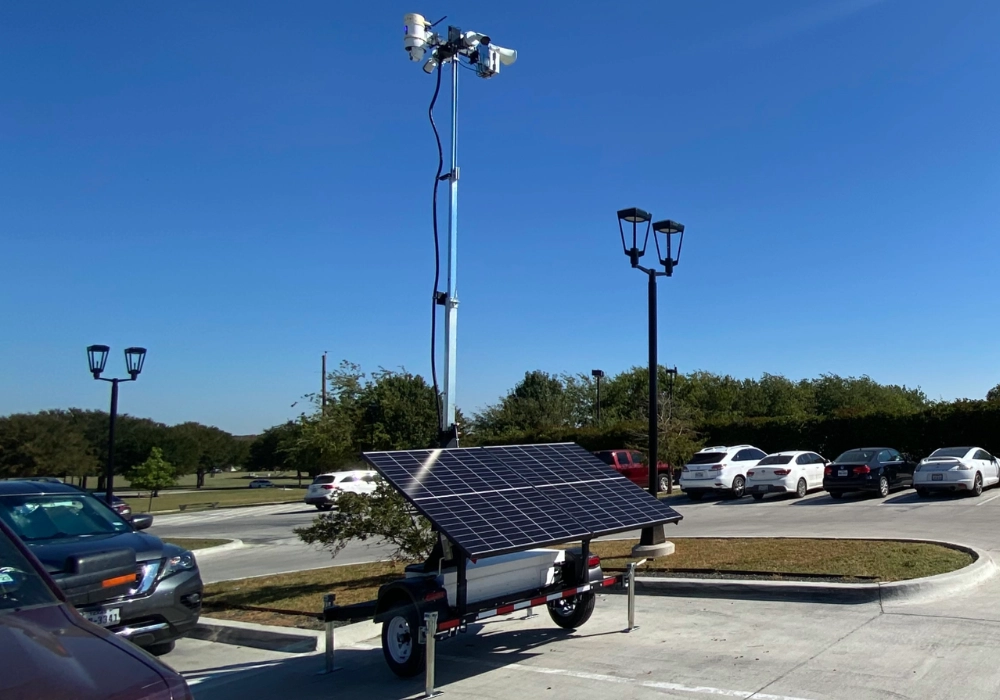
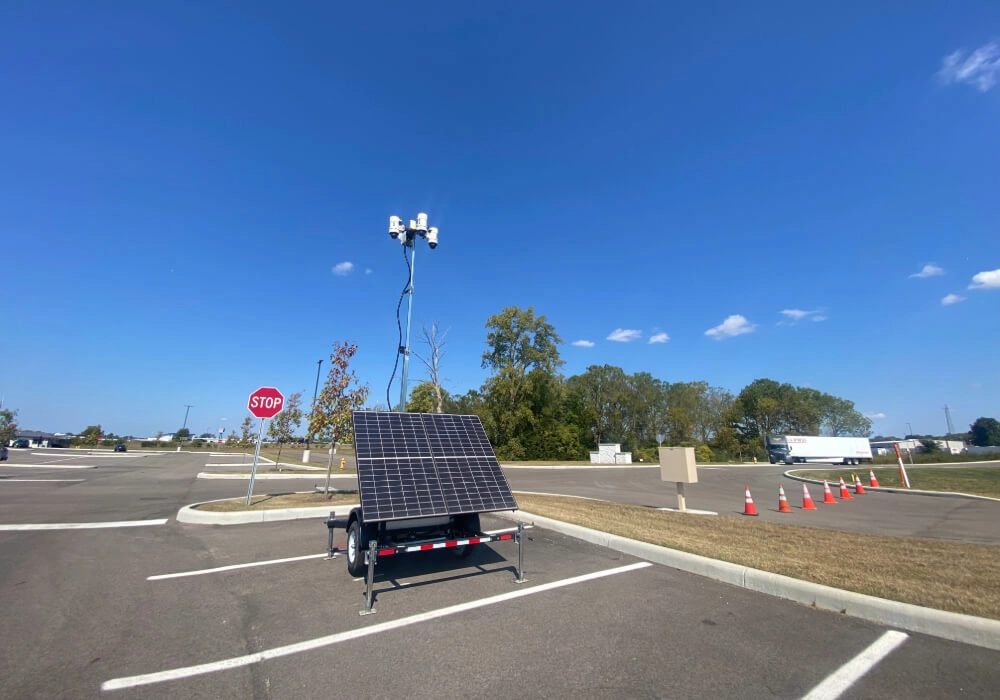
Newly acquired commercial real estate needs security that can deploy quickly and relocate as risks evolve. Rapidly deployable mobile surveillance trailers (like the LotGuardPRO) can be deployed in 20-minutes (basic setups), repositioned/relocated easily, and run entirely on solar power, providing reliable coverage even in remote locations.
Fitted with near-360° PTZ (Pan-Tilt-Zoom) cameras, AI-video analytics, and live video monitoring, they monitor and protect commercial assets both day and night, while timestamping incidents to create an audit trail for reporting and insurance purposes.
Consider add-on License Plate Recognition (LPR) technology to monitor vehicle activity at entry and exit points, parking areas, and other access points.
Opt for continuous site monitoring
Choose surveillance solutions with 24/7 remote monitoring to ensure suspicious activity doesn't go unnoticed after hours or when no one is physically on-site.
LotGuard offers 24/7 professional remote monitoring services as part of our fully-managed service. Every product (LotGuardPRO, LotGuardMINI, LotGuardMULTI) connects to an Interactive Surveillance Operations Center (ISOC) where trained operators review live footage, verify threats, and initiate near-instant responses such as issuing live audio voice-down challenges or contacting the police.
Centralize site data
The surveillance solution you choose should centralize all site data in one place, giving CRE investment managers a single view of activity across individual properties and entire portfolios.
Our cloud-based monitoring platform consolidates surveillance feeds, detection alerts, and vehicle data in a single dashboard, making it easier to monitor multiple sites remotely, review incidents, identify recurring patterns, generate reports, and maintain complete oversight of security activity from day one.
Review and adapt (ongoing)
A newly acquired asset can change quickly, and security property management needs to keep pace. Occupancy rates shift, construction moves through different phases, and the risk profile evolves with it. That's why reviewing your security strategy should be an ongoing process to establish what's working, what isn't, and adjust your coverage as the property evolves. Our mobile surveillance solutions can be self-moved as site requirements change, allowing coverage to be repositioned quickly as the asset progresses.
In practice, a risk assessment determines whether the property requires permanent security, temporary surveillance, remote monitoring, or a combination.
Read more:
- Protecting Value-Add Property Investments During the Acquisition-to-Lease-Up Phase
- A Comprehensive Property Management Risk Mitigation Framework
- Safeguarding Newly Won Commercial Listings with LotGuard
- The Complete Guide to Parking Lot Security
How to define the level of security coverage needed
|
Property situation |
Potential security requirement |
|
Fully occupied |
Permanent surveillance, access control |
|
Vacant property |
Temporary mobile surveillance, 24/7 remote monitoring, access control, LPR cameras, cloud-based platform |
|
Repositioning (construction/renovation) |
Temporary mobile surveillance, 24/7 live video monitoring, LPR technology, centralized platform |
|
Large-scale development site |
Mobile surveillance along perimeters, LPR at entry/exit points, 24/7 remote monitoring, centralized oversight |
Read more:
Quick post-acquisition security planning checklist
- Complete a property risk assessment
- Identify vacant, high-risk, and high-value areas
- Map vulnerabilities and access points
- Match coverage to the property's situation
- Deploy surveillance and set up professional monitoring
- Review and adjust as the asset moves toward stabilization
Protect Commercial Real Estate From Day One of Acquisition
The moment an acquisition closes, commercial investment managers become responsible for protecting the asset while delivering the projected returns. Newly acquired properties are particularly vulnerable during this early ownership stage, making a post-acquisition security plan essential.
Securing commercial real estate comes down to speed, flexibility, and portfolio-wide visibility, all of which LotGuard provides. By assessing the property's condition, pinpointing high-risk areas, and deploying mobile surveillance solutions, managers can reduce exposure to preventable losses and protect the investment from day one.
If you're interested in mobile parking lot surveillance that's "Always Awake and Always on Guard," contact one of our security specialists today.

Contents
[hide]Related news

7 Key Risk Factors to Monitor in Transitional Commercial Properties
Learn the biggest risks affecting transitional commercial properties, from theft and vandalism to fire and unauthorized access, and how to mitigate them. Read more
9 Benefits of All-in-One Surveillance Platforms for Commercial Real Estate Investors
See how integrated monitoring gives CRE investors greater oversight across properties while simplifying reporting and risk management. Read more

How Crime Impacts Cap Rates and Valuation for Commercial Property
High crime rates can quietly erode millions in property value. Learn how crime impacts cap rates and what it means for CRE investors. Read more
FAQs
What is commercial real estate acquisition?
Commercial property acquisition is the process of purchasing income-generating real estate, usually after conducting market research to identify potential growth, then working through negotiation, due diligence, and closing stages. The acquisition process isn't quick; real estate M&A deals can take as long as 1.5 years to complete (as of October 2023), and the period right after closing is often when an asset sits most exposed.
What security risks should CRE managers assess after acquiring a new commercial property?
There are several security risks CRE managers should assess after acquiring a new commercial property, including vacancy and occupancy levels, perimeter and access-point vulnerabilities, lighting, crime exposure, and threats such as theft, illegal dumping, vandalism, trespassing, and arson.
Why are commercial properties high-risk after acquisition?
Newly acquired commercial real estate, including office buildings, retail properties, and industrial properties, often sit vacant or partially occupied while the acquisition process is finalized. With fewer people on-site and less day-to-day activity, these premises can become more attractive targets for criminals, increasing the security risks for investors and property managers.
How to mitigate risk in commercial real estate acquisitions?
Every CRE investment comes with some level of risk, some more than others. Beyond physical security, managers address tenant risk through screening and lease review, market and economic risk through research and conservative underwriting, and financial risk through funding choices (e.g., private lenders offer faster funding but higher interest rates, etc).
How does crime impact business operations during CRE acquisition periods?
Crime during acquisition and repositioning can stall construction, delay lease-up, raise insurance costs, and create liability. All of these can disrupt business operations and push back when the asset reaches stabilization and income generation.
Contact Us
Request a Quote for LotGuard
Ready to learn more about how LotGuard can protect your Parking Lots and Properties? Get in touch today for a free quote.