
How Much Does Vacant Property Security Cost?
Discover the true cost of vacant property security and how different solutions compare in price, coverage, and effectiveness.
How much does it really cost to leave a vacant building unprotected, even for a few weeks?
For property teams managing vacant buildings, poor security can quickly lead to hefty repair bills and lower property values, even from a single incident.
Property managers already know that vacant properties are soft targets for criminal activities. Without regular eyes on site, the risk of vandalism and squatting rises quickly, and so do repair costs, insurance premiums, and vacancy timelines. The longer a building sits empty, the more those threats compound.
Being reactive rarely works and almost always costs more than getting ahead of the problem. However, with numerous security options available, ranging from perimeter fencing to mobile surveillance, understanding the actual costs and benefits of each approach makes a significant difference in how budgets are allocated.
This article breaks down how much vacant property security costs, giving property management teams an insightful and cost-effective way to protect unoccupied buildings.
Types of Vacant Building Security
There's no single security measure that covers every risk vacant properties face. In practice, the most effective strategy layers several measures together (physical deterrents, lighting, active monitoring) based on the size of the site, its location, and how long it stands empty.
Here's a quick overview of the main types of security and what they typically cost:
Physical barriers
Physical barriers are often the first line of defense for vacant buildings, making unauthorized access harder and sending a clear message that the site is secured. For commercial properties, this generally means perimeter fencing, reinforced doors and windows, and in some cases, steel or concrete barriers around high-risk areas such as parking lots.
Anti-climb fencing typically costs between $30 and $60 per linear foot and is one of the most cost-effective options to secure exterior spaces. Commercial-grade 3D wire panel systems range from $200 to $350 per panel, excluding labor costs and installation.
Read more: The Importance of Perimeter Security for Commercial and Industrial Properties
Access control
Access control systems cover everything from reinforced locks and keypads to motorized gates and smart entry systems. For vacant properties, the purpose of this kind of security is to prevent unauthorized vehicle and pedestrian (loiterers, squatters, trespassers) access at known entry points.
Basic digital lock systems cost roughly $100-$400 for the hardware alone, while high-end biometric or video-enabled systems can exceed $600 per unit. Total costs for electric gates range from $2,000 to $12,000+, depending on gate material and size.
For properties facing extended vacancies or frequent tenant turnover, automated access control can be worth the upfront cost by reducing trespassing and limiting liability, especially when paired with remote monitoring and active surveillance.
Read more: Understanding How to Manage Vacant Properties in Texas
Lighting and maintenance
Adequate lighting is one of the most cost-effective ways to deter criminals. A vacant property or surface lot that's poorly lit makes it much easier for criminals to operate undetected, particularly after hours when there are fewer people around.
Reports show that up to 70% of parking lot crimes, including vandalism, loitering, takeovers, and vehicle theft, occur after dark. Strategically placed lighting (costing around $50-$300 per fixture) increases visibility and helps security teams or passersby spot issues before they escalate.
Routine maintenance plays an important role, too. Burned-out bulbs, overgrown landscaping, piles of trash, and visible signs of neglect signal to potential offenders that a property is unmonitored. Keeping exterior areas well-lit and tidy reinforces the fact that sites are actively looked after, even when vacant.
Read more: Nighttime: The Biggest Security Threat for Property Managers
Security guards
Using a security guard company serves as a physical deterrent against opportunistic and organized crime, responding to incidents as they happen. For vacant buildings, whether residential, industrial, or commercial, this typically means roaming patrols or stationary security guards at fixed points.
Full-time, unarmed security guards cost around $30-$45 per hour, while armed guards have an average hourly rate of $55-$75. Specialized security guard services (such as ex-military personnel) often exceed $75 per hour. For round-the-clock security at a single vacant property, that equates to roughly $265,000-$620,000 annually, before factoring in overtime, ongoing training, insurance, and benefits.
Read more: Commonly Asked Security Questions From Property Managers
Technology and surveillance
Surveillance technology has advanced tremendously in recent years, and solar-powered units in particular have made security in remote locations much easier. Unlike fixed security cameras, which require mains power and internet to operate, mobile units operate autonomously and can be deployed within minutes without permanent infrastructure.
AI analytics, PTZ (Pan-Tilt-Zoom) cameras, smart detection, license plate recognition (LPR), and remote monitoring provide a level of continuous coverage that basic systems simply can't match. Modern mobile surveillance protects high-value assets 24/7 at a fraction of the monthly cost of security guards.
Read more: Why Property Managers Shouldn't Overlook Remote Monitoring
Comparing Vacant Property Security Costs and Coverage
The table below provides a general cost and coverage comparison across the main security options for vacant commercial properties. Costs vary depending on property size, location, and specific security specs.
| Security type | Cost estimation | Coverage | Flexibility |
| Physical barriers (fencing) | $10,733 to $21,466 (for 8,000 sq. ft retail property) | Perimeter | Low (fixed once installed) |
| Access control | $200-$12,000 per entry point/gate entry | Entry points | Medium |
| Lighting upgrades | $1,000-$6,000 (for 20 fixtures) | Exterior area/s | Low (fixed once installed) |
| Security guards (unarmed guards) | $262,800- $394,200 annually (for 24/7 daytime and overnight coverage) | On-site | High (scalable, but expensive) |
| Mobile surveillance (LotGuard) | Request a quote | Near-360° | High (rapid deployment and easy to relocate) |
Figuring out which security is best for your vacant site comes down to property size, exterior exposure, parking facilities, budget, and vacancy duration, all of which directly influence your security needs.
Read more: Top Security Challenges for Property Managers and How to Overcome Them
The Cost of Inaction and Lack of Security for Vacant Real Estate
Without sufficient security, empty real estate quickly becomes vulnerable to a range of threats that escalate in both frequency and severity the longer a site remains unprotected.
These include:
-
Vandalism and property damage: Deliberate structural damage and graffiti are common issues at unmonitored sites. Beyond immediate repair costs, visible damage shows neglect, which can potentially attract further criminal activity. This creates a domino effect of property crime and challenges for property managers, owners, and tenants alike.
-
Squatting and unauthorized entry: Once a squatter settles into an unoccupied building, removing them legally is a slow and expensive process. What's more, interior damage from break-ins can run into thousands of dollars in repairs.
-
Copper theft: HVAC systems, copper wiring, and plumbing fixtures are usually the first things to be stripped from vacant real estate due to their high resale value on illicit markets.
-
Lower property value: Vacant properties in high-crime areas typically have lower Net Operating Income (NOI) and higher capitalization (cap) rates. When tenants feel unsafe, leasing demand dips while operating expenses remain the same, eroding cash flow and ultimately reducing the property’s market value.
-
Insurance complications: Most standard insurance policies exclude (or restrict) coverage when a property stands empty for 30-60 consecutive days. Without security, property owners/management teams risk having claims rejected or denied, or paying for damages out of pocket.
-
Liability risks: Even if someone enters your site illegally, you may be held liable if someone is injured on-site. Compensation claims can cost thousands of dollars. Liability insurance is recommended to avoid this, often costing a fraction of the price of any liability claim.
Read more:
On-site Security Personnel vs Mobile Monitoring for Vacant Sites
Both on-site security services and mobile surveillance protect vacant properties. However, they serve different needs and come with very different costs and coverage implications.
Below, we take a closer look at how on-site security guards and mobile monitoring surveillance measure up:
| Feature | Security guards | Mobile surveillance |
| Visible deterrent | [[YES]] | [[YES]] |
| 24/7 exterior coverage | [[NO]] | [[YES]] |
| Remote monitoring | [[NO]] | [[YES]] |
| Rapid, real-time response | [[NO]] | [[YES]] |
| Documented evidence | [[NO]] | [[YES]] |
| Predictable monthly cost | [[NO]] | [[YES]] |
Security guards provide a physical human presence that can detect and deter criminal activities, but only when they're "at the right place at the right time". When incidents do occur, documentation relies on eyewitness statements and memory, which may not always be accurate and carry little weight in insurance claims or legal disputes.
That said, for vacant sites with high-value assets or those in areas with higher crime, having on-site personnel can still play a useful role.
However, that added protection comes at a cost. Using a security company can be expensive, especially when 24/7 coverage is needed. Even with consistent base rates, overall budgets can escalate once benefits, overtime, and employee insurance are factored in. What's more, a single guard can't patrol every square inch of a property simultaneously, leaving blind spots that criminals exploit.
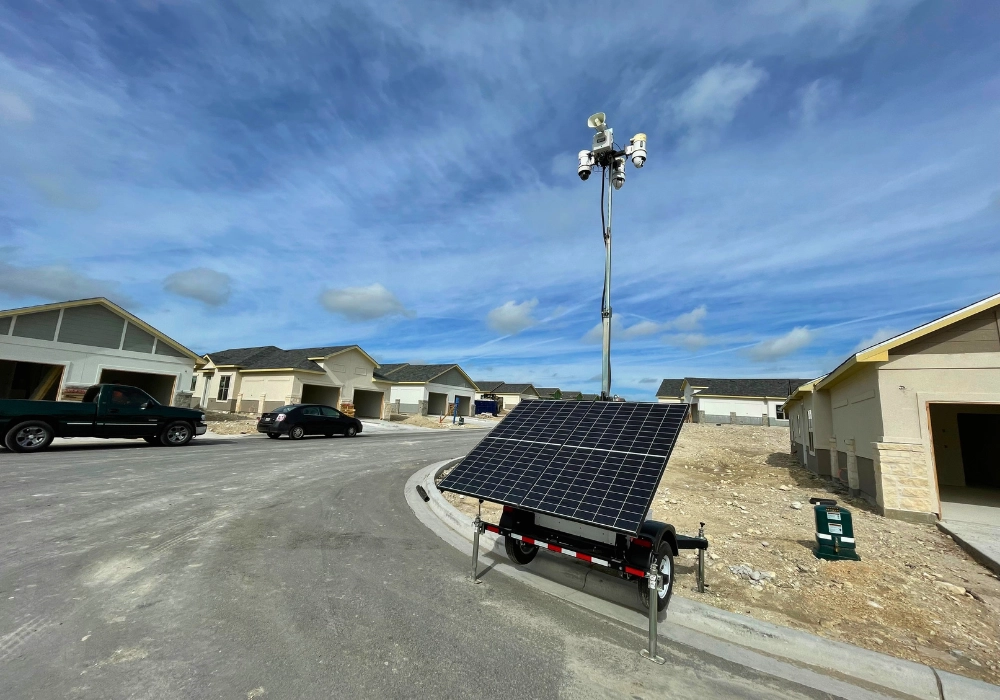
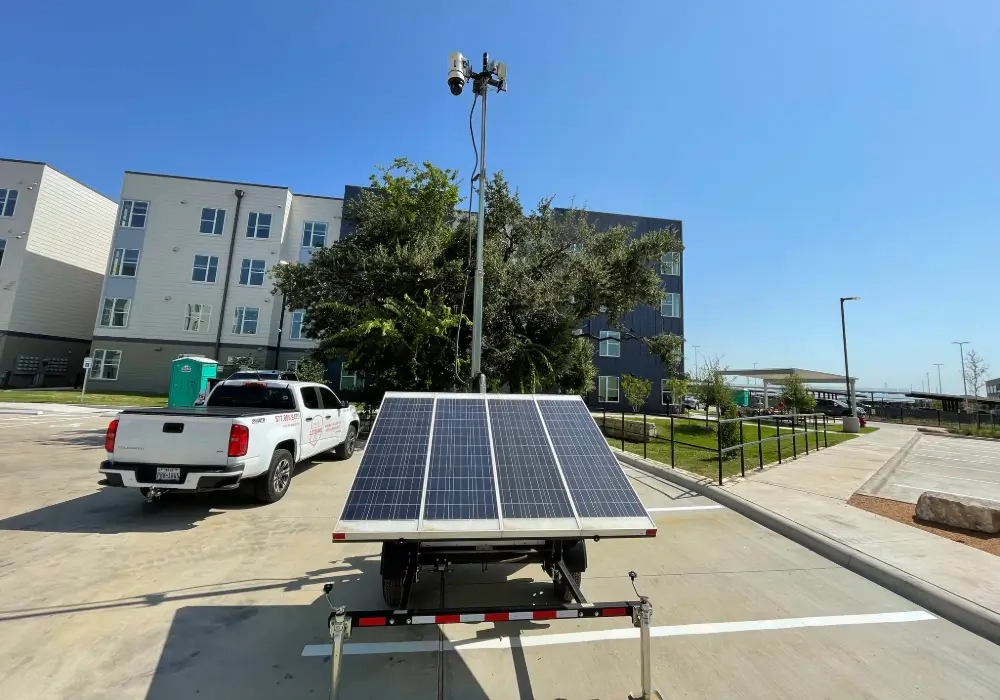
Mobile surveillance, on the other hand, such as the LotGuard PRO, provides near-360° visibility across your entire site. Each solar-powered surveillance trailer unit stands up to 20-feet tall and is equipped with night vision PTZ (Pan-Tilt-Zoom) cameras, AI analytics, and remote monitoring linked to Interactive Surveillance Operations Centers (ISOCs).
When the system detects suspicious behavior, trained operators verify the incident and initiate near-instant responses, such as issuing live audio voice-down challenges and/or contacting emergency services when needed. Continuous monitoring, automated timestamped evidence, and real-time alerts are standard, protecting vacant land and exterior spaces at a fraction of the cost of security guards.
For property professionals managing several vacant properties at once, our cloud-based platform consolidates everything into a single view. From one dashboard, teams can access live and recorded footage, review incident alerts, and generate reports on demand, without needing staff present at each location.
LotGuard’s mobile parking lot surveillance systems are available on flexible rental terms, offering a predictable, cost-effective security solution that can scale up or down as vacancy periods (and budgets) change.
Read more: Vacant Property Security: Guard Services vs Mobile Surveillance
Protect Your Vacant Property Before It's Too Late
The cost of securing a vacant property is almost always lower than leaving it unprotected. Vandalism, copper theft, and squatting are real risks, but they're also preventable when the right measures are in place.
That's why many commercial property managers and owners are turning to proactive, tech-led solutions to secure exterior spaces. With headquarters in Texas and a nationwide deployment network, LotGuard's systems help reduce crime by up to 87% while costing a fraction of on-site guard services.
If you're looking for a cost-effective security solution for your unoccupied buildings, contact our team today.

Contents
[hide]Related news

Vacant Property Security: Guard Services vs Mobile Surveillance
Compare guard services and mobile surveillance for vacant property security and learn which option offers better protection and cost efficiency. Read more

The Hidden Cost of Vacancy in Commercial Real Estate (Beyond Lost Rent)
Explore the hidden costs of vacancy in commercial real estate, from security risks to asset deterioration and operational impact. Read more

How Squatting Laws Differ by State
Find out all 50 states' squatter laws in the US. See how LotGuard's mobile parking lot surveillance can protect your vacant properties. Read more
FAQs
What is the price to secure vacant land?
The cost to secure vacant premises largely depends on the property's size, layout, and security risk factors and needs. Large properties typically cost more to secure, while smaller areas are cheaper.
Why do vacant properties need security?
Vacant properties need security as they are 3 to 5X more likely to experience theft, vandalism, homeless encampments, and squatting. All of these pose serious safety, liability, and financial risks for property owners in the United States.
What makes empty buildings more prone to crime in the United States?
Several environmental risk factors increase property crime exposure in the US, such as visible signs of neglect, unsecured access points, and limited security.
Contact Us
Request a Quote for LotGuard
Ready to learn more about how LotGuard can protect your Parking Lots and Properties during the holidays? Get in touch today for a free quote.