
Vacant Property Security: Guard Services vs Mobile Surveillance
Compare guard services and mobile surveillance for vacant property security and learn which option offers better protection and cost efficiency.

Vacant properties tend to experience more theft and vandalism and face a much higher risk of arson compared to occupied buildings. With several environmental risk factors working against them, they easily become targets for criminal activity and costly damage.
Because there are fewer people on-site, property owners and management teams are often torn between 2 security options to protect vacant property: guard services vs mobile surveillance.
Both have a role to play, but they work very differently in terms of cost and reliability, especially when securing large exterior areas or long-term vacancies.
This article compares these 2 options side by side, breaking down how each performs across large exterior areas, so property professionals can decide which approach best aligns with their specific security needs.
Why Vacant Properties Attract More Criminal Activity
Vacant properties are 3 to 5X times more likely to experience property crime, including theft, vandalism, homeless encampments, and squatting, than inhabited buildings. With little to no on-site presence, these properties offer low-risk, high-reward options for both opportunistic and organized crime groups.
What makes them more vulnerable to security risks?
-
No "natural surveillance" to deter crime, particularly after-hours and/or in isolated locations.
-
Poor lighting along perimeters, surface lots, and entry points.
-
Limited boundary control and protection (or the lack thereof).
-
Visible signs of neglect (lack of upkeep) signal that the property is unmonitored.
-
Lack of surveillance systems covering the property's exterior areas (parking lots, perimeters).
-
Construction activity during renovations or transitional periods.
In the US, property crime occurs roughly every 3.9 seconds, making it one of the most common criminal offenses nationwide. When combined with the estimated 15 million vacant properties across the country, the scale of exposure cannot be ignored, leaving owners and property managers facing heightened security and financial risks.
Vacant commercial and residential sites attract a wide range of dangers:
-
Metal theft targets copper wiring and HVAC systems for their high resale value on illicit markets.
-
Vandalism, graffiti, and structural damage erode property values.
-
Squatting, once established, can take months and thousands of dollars in legal fees to resolve.
-
Illegal dumping is a persistent problem, impacting property values and deterring potential tenants.
Read more:
Vacant Property Guard Services: Explained
Guard services involve hiring professional security personnel to patrol your site and act as a physical presence to deter trespassers and criminals. Their job is to protect unoccupied buildings from theft, vandalism, squatting, and antisocial activity.
Security guards can be stationed at a fixed post, such as a gate or main entrance access control point, or assigned patrol routes that cover the property at set times. Some providers offer a combined security solution, where a guard is stationed during high-risk hours with roaming patrols overnight.
Because vacant properties lack natural surveillance and are often poorly maintained, they are more attractive to intruders and arsonists. Guard services reduce this risk by providing a physical deterrent and acting quickly if incidents occur. However, they need to be "at the right place at the right time" to do so.
Where security guard services are commonly used:
-
High-value transitional properties where immediate action is essential.
-
Properties in high-risk environments that require a visible human presence.
-
Short-term security needs during construction work or tenant changeover.
-
Sites where insurance policies mandate active security services.
Read more:
Mobile Surveillance for Vacant Properties: Explained
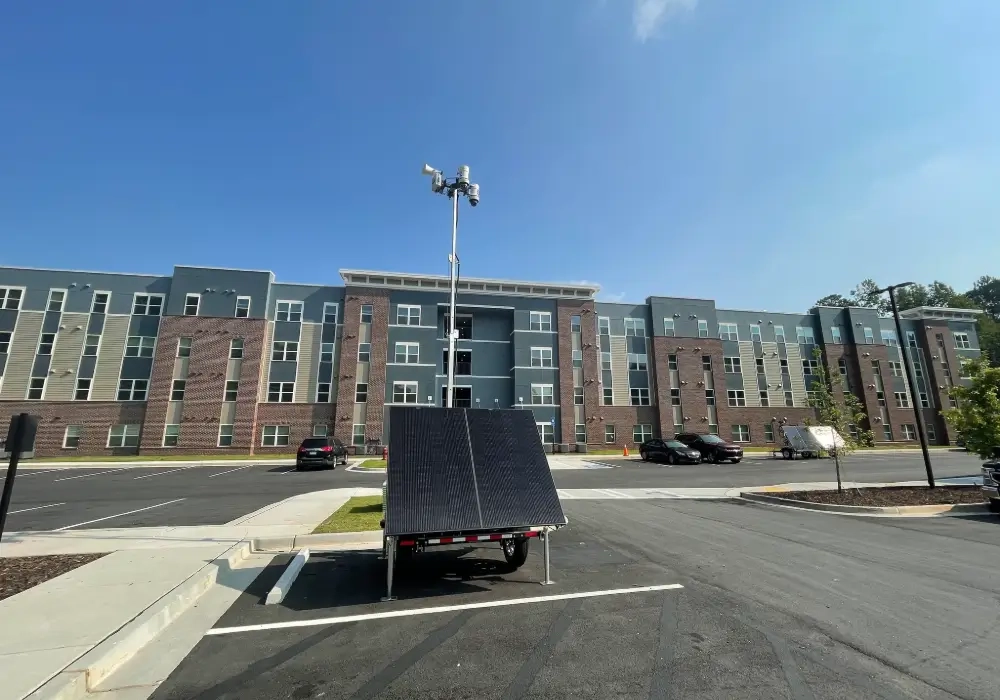
Mobile surveillance units use smart technology to secure vacant properties. Unlike security guards who rely on physical presence, these systems use smart PTZ (Pan-Tilt-Zoom) cameras, AI-detection, remote access, and live video monitoring to detect and deter suspicious behavior across a site's exterior.
When something unusual is caught by surveillance cameras, smart units trigger instant alerts. This allows for quick intervention or corrective action, stopping crime before it escalates. Their rapid response capabilities help stop theft and unauthorized access before damage or loss occurs with little to no human input.
Modern mobile surveillance units, like solar-powered surveillance trailers, operate autonomously. They don't need fixed power or Wi-Fi, making them ideal for vacant properties in remote locations or where permanent infrastructure is limited. Streaming site footage via secure 4G/5G networks, trained operators at Interactive Surveillance Operations Centers (ISOC) verify potential threats in real-time and initiate various responses on a property owner's behalf.
Because mobile security solutions don't take breaks or vacations, they provide consistent coverage without fatigue or downtime. By filtering false alarms and only focusing on genuine risks, these solutions can reduce crime by up to 87%. With near-360° coverage and rapid response capabilities, smart mobile units provide continuous monitoring and better oversight than on-site guards, particularly across multiple sites.
Where mobile surveillance is commonly used:
-
Retail stores, both occupied and vacant, to deter theft and after-hours intrusions.
-
Commercial and industrial properties, especially those standing empty or awaiting development.
-
Active construction sites that require constant monitoring to prevent copper theft and trespass.
-
Large exterior spaces, such as open perimeters, campuses, and parking lot security.
-
Rural or remote properties where security guards aren't practical.
-
Multi-site portfolios where property owners/managers need centralized visibility across locations.
Read more: Why Property Managers Shouldn't Overlook Remote Monitoring
Traditional Security Guards vs Mobile Surveillance
Both traditional security guards and mobile surveillance solutions offer property protection, but they differ in how they achieve it.
Let's compare the 2 across the factors that matter most to property managers and owners:
| Factor | Security guards | Mobile surveillance units |
| Cost | High, especially across multiple sites | Cost-effective solution; rentals |
| Reliability | Requires physical presence; prone to human error, illness, fatigue, and vacation time off | Consistent, 24/7 monitoring regardless of lighting, weather, or time of year |
| Coverage | Limited to where the guard is at a given time | Near-360° visibility |
| Response capabilities | Delayed, unless guards are "at the right place at the right time" | Near-instant with human verification at remote monitoring centers |
| Evidence | Relies on eye witness testimonies and handwritten incident reports | Automatic timestamps create clear audit trails in consolidated cloud platforms |
| Scalability | Expensive; requires more guards as portfolios expand | Cost-effective |
The right security option ultimately comes down to your property's size, location-specific needs, and vacancy timeline.
Cost
Full-time guards cost around $30-$50 per hour, with armed response officers costing closer to $70 per hour, depending on location. For 24/7 coverage at a single vacant property, that's roughly $262,000-$613,000 annually, before accounting for overtime and management overhead.
Mobile surveillance, on the other hand, operates on a predictable monthly cost (rental) with no staffing costs or HR burden. For multi-site portfolios, the cost difference is substantial.
Reliability
A guard is only effective when alert and physically present. Fatigue, illness, no-shows, and human error are real operational risks, particularly on overnight shifts at vacant sites where activity is minimal for hours at a time.
Mobile surveillance units' AI detection runs 24/7 without getting tired or losing concentration. Safety risks are flagged in real-time, and trained ISOC operators initiate various responses (e.g., flashing lights, live audio voice-down challenges) without on-site support.
Coverage
Security guards can only be in one place at any given time. On large vacant properties with multiple access points and parking areas, periodic patrols inevitably create blind spots that criminals exploit.
Mobile surveillance units equipped with multiple PTZ cameras use infrared (IR) night vision and License Plate Recognition (LPR) technology to monitor wide areas simultaneously. With near-360° visibility and up to 23X optical zoom, they help ensure vacant properties and valuable assets remain continuously protected, day and night.
Response times
On-site security guards can only respond to incidents if they are physically present at the moment an issue occurs. In many cases, incidents are discovered after the fact, with damage or theft already having taken place and reported during routine patrols or shift changes.
Mobile surveillance units trigger near-immediate action when something suspicious is picked up on surveillance cameras. Remote monitoring allows ISOC operators to review alerts in real-time, which leads to faster verification, swifter decision-making, and quicker intervention before incidents escalate.
Evidence
When incidents occur at vacant properties, available evidence often depends on security guard eyewitness accounts and handwritten incident reports. While valuable, this approach relies heavily on human observation and memory, which can vary in accuracy.
Mobile surveillance systems automatically log every incident with a precise timestamp, creating a clear audit trail for internal reports, insurance claims, and legal enforcement investigations.
Scalability
Scaling security guards across multiple properties is expensive. By multiplying headcount, managing guard services across 5 or 10 sites becomes a logistical nightmare.
Mobile surveillance units deploy in minutes, can be relocated or scaled as needs change. They connect to centralized cloud platforms that give property managers visibility across their entire portfolio from a single dashboard, making it a cost-effective solution for those managing multiple sites.
Mobile Surveillance Security Options for Vacant Properties
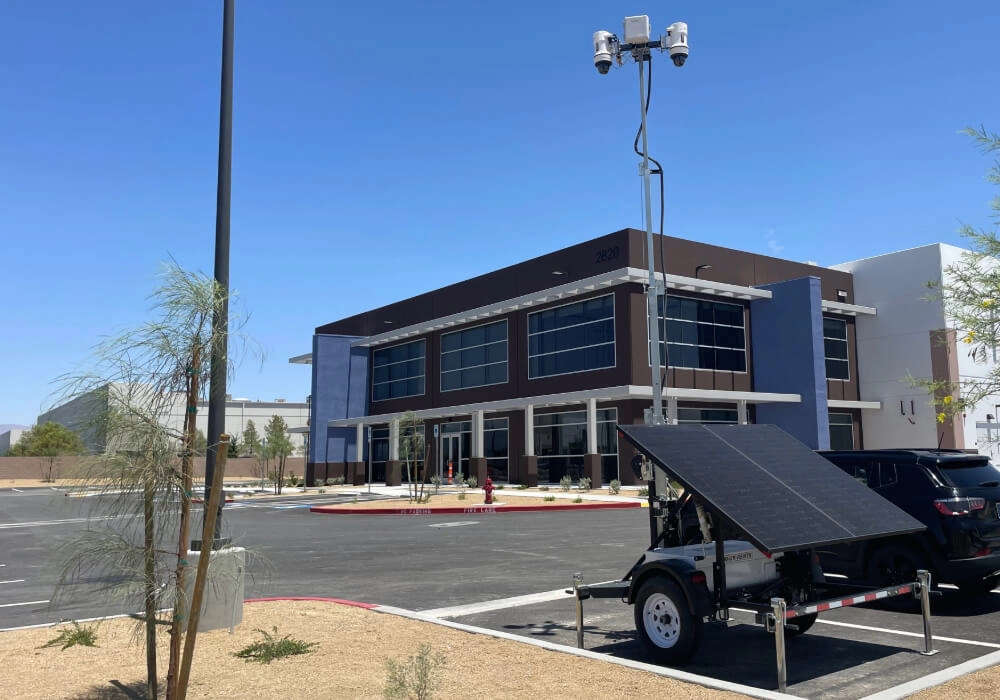
LotGuard's mobile parking lot surveillance systems protect vacant properties from theft and vandalism. Combining AI detection, remote access, and remote monitoring, they maintain clear visibility both night and day.
-
LotGuard PRO: A solar-powered mobile surveillance trailer standing up to 20-feet tall that can be deployed to any vacant property's lot in minutes. Using AI detection and cameras that rotate nearly 360°, it deters crime before it begins.
-
LotGuard MINI: A small, 4-camera pole-mounted surveillance system designed to secure parking lots and vacant sites. Transmitting footage securely over 4G/5G networks, property management teams can review real-time site data without being physically on-site.
-
License Plate Recognition (LPR) cameras: As add-on cameras to the LotGuard PRO and MINI, these systems track and record all vehicle movement in and around vacant sites. Systems gather information such as vehicle model, make, and color, and provide a timestamped audit trail that helps identify repeat vehicle activity.
-
Stellifii: Our cloud-based platform that connects every LotGuard system. Stellifii gives you access to real-time site activity from any device, consolidating camera feeds, incident alerts, LPR data, and AI detection into a single dashboard. Export reports to support insurance claims and compliance audits in minutes.
LotGuard is headquartered in Texas, with multiple hubs and a deployment network covering the entire US. All units are available for hire, giving property management teams scalable security without upfront capital investment.
Read more: Why Property Managers are Turning to LotGuard for Security
Protect Vacant Properties the Smart Way
Vacant properties don't protect themselves, and the costs of leaving them unsecured (theft, vandalism, squatting) almost always exceed the cost of prevention by a wide margin.
LotGuard's mobile surveillance solutions are purpose-built for protecting vacant properties and their surrounding exterior environments. Our fully-managed service covers everything from equipment installation to live monitoring, technical support, and monthly reporting, so property managers stay informed without adding security management to their workload.
Interested in finding out how our mobile parking lot surveillance solutions can protect your vacant lot? Speak to a LotGuard security expert today.

Contents
[hide]Related news

The Hidden Cost of Vacancy in Commercial Real Estate (Beyond Lost Rent)
Explore the hidden costs of vacancy in commercial real estate, from security risks to asset deterioration and operational impact. Read more
Top 10 Commercial Property Hotspots for Copper Theft Risk
Discover the top commercial property hotspots for copper theft risk and how businesses can better protect high-value assets. Read more

The State of Property Crime in the US (And How to Protect Yours)
Explore the current state of property crime in the US and learn how smarter security solutions can help protect your property. Read more
Contact Us
Request a Quote for LotGuard
Ready to learn more about how LotGuard can protect your Parking Lots and Properties during the holidays? Get in touch today for a free quote.