
The State of Property Crime in the US (And How to Protect Yours)
Explore the current state of property crime in the US and learn how smarter security solutions can help protect your property.

According to the Federal Bureau of Investigation (FBI), property crime occurs in the United States every 3.9 seconds, making it one of the most common criminal offenses in the country. These crimes include burglary, larceny, and motor vehicle theft, and may also involve arson and vandalism.
Whether you're managing a commercial office park, a transitional yet vacant building, or retail sites, theft and unauthorized access are ongoing concerns that can quickly disrupt operations.
The good news? Property crime rates dropped by roughly 30% between 2013 and 2023, but national averages don't tell the full story. Crime varies by location and property type, with certain environmental factors, such as low occupancy rates and poor surveillance, making some sites more vulnerable than others.
In this article, we'll cover the current state of property crime in the US, which property types face the highest risk, and how modern mobile surveillance can help keep your properties safe.
Property Crime in the US: Facts and Stats
In the US, property crime is very common and has a devastating effect on households, businesses, and local economies every day. From theft and burglary to vehicle break-ins and vandalism, these incidents affect both residential and commercial properties, creating ongoing challenges for owners, tenants, and property managers alike.
Looking at current property crime statistics sheds light on where these incidents are most likely to occur. Factors such as economic pressures, population density, and vacancy levels all influence crime patterns, which can vary widely from state to state.
Here's what the US property crime data shows:
-
Over 6 million property crimes were reported in 2023, totaling $28B in stolen personal property.
-
Larceny accounted for 70% of all property crime incidents in 2023.
-
The average residential burglary rate was 17% lower in 2025 than in the previous year.
-
Florida's property crime rate has declined by nearly 79% since 1991.
-
Over 800,00 burglaries were recorded by the FBI, with rates increasing by 11% in Illinois (2022-23).
-
Washington has the highest motor vehicle theft rate (681.2 per 100,000 inhabitants), while New Hampshire has the lowest property crime rate (59.6 per 100,000 inhabitants).
Property crime rates by state:
| Highest property crime rate | Lowest property crime rate |
| New Mexico | Idaho |
| Washington | New Hampshire |
| Colorado | Massachusetts |
| Louisiana | Maine |
| Oregon | Rhode Island |
Property crime trends: Over the last 30 years, crime rates in the US have declined by roughly 60%, resulting in a fairly consistent downward trend. At peak levels, there were about 5,000 reported offenses for every 100,000 people, roughly one crime per 20 people each year. In 2024, that figure dropped significantly, with reported crime rates falling to fewer than one per 50 people annually.
That said, property crime has not disappeared. Incidents still occur and can result in substantial financial losses and long-term security implications for businesses and property owners. As a result, having a robust surveillance strategy is of the utmost importance.
Read more: Why Property Managers Shouldn't Overlook Remote Monitoring
Common Types of Property Crime in America
Understanding what you're up against is the first step to protecting your property. According to the FBI's Uniform Crime Reporting (UCR) Program, property crime involves the theft or damage of property without the use or threat of force. This covers several offenses, from burglary to arson, that commonly affect residential and commercial properties across the US.
Burglary
Burglary is the unlawful entry into a property with the intention to commit theft or another felony. Residential properties accounted for 53% of all burglary offenses in 2023, but commercial properties (particularly those with inconsistent occupancy) are also a target. Organized crime groups (OCGs) have become incredibly sophisticated in scouting and exploiting soft entry points.
Larceny theft
Larceny theft is the most common type of property crime in the US, outside of auto theft and fraud. It refers to the unlawful theft of property without forcible entry, and includes offenses such as shoplifting, pocket-picking, and theft of equipment and tools from commercial sites.
In 2023, around 4.5 million larceny offenses were reported nationally, accounting for 70% of all property crime incidents. Given how often these incidents occur, larceny theft poses a significant and ongoing risk for businesses and property managers/owners.
Read more: Understanding and Preventing Commercial Theft
Auto theft
Even though motor vehicle theft rates fell by 27% between 2024 and 2025, it's still a serious issue, especially in states like Washington and Nevada. Surface parking lots are a magnet for multiple forms of criminal activity, from vehicle theft to illegal encampments and loitering. Criminals exploit these soft targets where poor visibility and gaps in surveillance coverage make it easy for theft to go unnoticed.
Read more: Most Commonly Stolen Cars in 2025
Vandalism
Vandalism is a deliberate act of property damage, including graffiti, smashed windows, damaged fixtures, and other crimes. These incidents often lead to costly repairs and replacements, creating unnecessary expenses for property owners and management teams.
Vandalism is also a bit of a double-edged sword. Visible signs of neglect (like graffiti, prolonged vacancy, and damaged infrastructure) can signal weak security and even attract more criminal activity. When a property looks rundown, whether that's a residential or commercial site, they become an easier target for criminals.
Read more: The Main Threats to Vacant Properties
Trespassing
Trespassing means someone gains unauthorized entry onto a property, without permission, whether intentionally (i.e., for criminal activity) or accidentally. While it's an obvious safety concern, it can also lead to real liability risks. If a trespasser is injured on-site, property owners may be held responsible, even though the person shouldn't have been there in the first place.
On large commercial or industrial properties, trespassing often goes undetected, particularly when there's no active monitoring in place. Empty buildings, unfinished construction zones, and unsecured access points can make it easy for unauthorized persons to stay on-site for a long time.
Arson
Arson refers to the deliberate setting of fire to property. Vacant and transitional buildings are at a higher risk of arson, particularly where signs of neglect suggest a lack of surveillance presence.
Fires started intentionally can spread quickly, putting neighboring properties and infrastructure at risk. Beyond the immediate damage, arson-related incidents often result in prolonged site closures, hefty repairs, and increased insurance premiums following a claim, creating unnecessary financial and operational pressure for property managers and owners.
Read more: Commonly Asked Security Questions From Property Managers
Illegal dumping
Illegal dumping is a serious problem in the US, particularly at vacant and/or under-managed properties. Abandoned (or poorly maintained) sites often attract this type of crime due to the perception that activity will go unnoticed.
Illegal dumping is not only unsightly but can also pose serious risks to public health and safety, including exposure to hazardous materials and pest infestations. Over time, dumping can damage surrounding property values and contribute to wider community degradation. To stop this from happening, early detection and deterrence are essential for property owners with vacant and transitional properties.
Property Types Facing the Highest Exposure
Not all properties carry equal risk. Certain characteristics, like occupancy levels and high-value assets, make some property types considerably more vulnerable to criminal activity than others.
Vacant and transitional properties
Vacant properties are 3 to 5X more likely to experience theft and vandalism than occupied buildings, making them at higher risk of property crime. With roughly 15 million vacant properties across the United States, the scale of exposure is significant.
What makes them more vulnerable? Overgrown gardens, uncollected mail, a rundown appearance, and signs of vandalism like graffiti and structural deterioration. Without regular occupancy to detect and report criminal activity, incidents can escalate before anyone even notices.
For property managers and real estate investors overseeing transitional assets (e.g., those under construction or awaiting tenants), the risks include copper theft, squatting, homeless encampments, and illegal dumping.
Read more:
Commercial and retail sites
Office parks and retail centers face a different, but equally persistent, set of risks. While these properties see constant activity during business hours, they often become quiet and poorly monitored after hours, creating the exact gaps where many commercial property crimes occur.
Large, mostly empty parking lots (retail, mall, commercial) with multiple access points make it easier for thieves, loiterers, and squatters to move quickly and remain unnoticed. Nighttime increases the risk of crime, such as motor vehicle theft, vandalism, and even illegal activities like drag racing, especially when lighting and security are limited.
For property management teams, these incidents are especially disruptive and stressful. Without ongoing surveillance and/or License Plate Recognition cameras (LPR), issues often aren't discovered until the next morning, by which point the window for intervention (or to gather useful information) has already closed.
Read more:
Construction sites and industrial facilities
Construction sites are frequent targets for property crime, costing the industry an estimated $300 million to $1 billion each year, with more than 1,000 thefts reported monthly. High-value equipment, building materials, and especially copper metals are easy to resell on illicit markets, and organized crime rings are well aware of this.
The impact of this property crime in the US? Even a single incident can derail project timelines and trigger hefty repairs and replacements. For construction and property managers, equipment theft isn't just an inconvenience; it's a risk that can quickly snowball, making crime prevention the only viable solution.
Read more: The Importance of Perimeter Security for Commercial and Industrial Properties
6 Conditions that Expose Properties to Crime
Property crime is primarily opportunistic. Remove the opportunity, and most criminals move on to an easier target. The conditions that create opportunity are consistent across property types and largely within a property manager's control.
Below, we’ll explore the conditions that make property crime in the United States more likely:
-
Poor perimeter lighting: 70% of property crimes occur under the cover of darkness, where visibility is low, and activity is minimal. Unlit corners and parking areas create blind spots that surveillance systems can't compensate for on their own. Bright perimeter lighting (especially at entry and exit points) is one of the most cost-effective deterrents available.
-
No visible surveillance: Criminals exploit properties with no active monitoring, as it signals a low-risk target compared to buildings that have it. Visible pole-mounted cameras and surveillance trailers function without fixed power or internet, and combine remote access and live monitoring to help prevent crime and maintain clear visibility across your property.
-
Basic monitoring systems: A basic surveillance camera that records footage does little to prevent crime as it unfolds. Without live monitoring or the ability to respond as crime happens, even the best-placed camera tends to capture evidence after the fact rather than prevent it.
-
Predictable vacancy patterns: Properties that are consistently unoccupied at the same times (e.g., overnight, weekends) allow criminals to plan their unlawful taking of property. Predictability is the epitome of property offenses.
-
Unsecured access points: Multiple, unsecured entry and exit points make it easier for thieves to access a property. Weak (or missing) perimeter fencing can invite suspicious activity and increase the likelihood of such crimes associated with damaged or stolen property.
-
Visible signs of neglect: Broken fixtures, graffiti that hasn't been cleaned up, overgrown gardens/sidewalks, and structural damage give criminals the "green light" that a property has limited monitoring and occupancy.
Read more: Top Security Challenges for Property Managers and How to Overcome Them
Passive Security vs Monitored Mobile Surveillance
Not all security and surveillance solutions deliver the same level of protection for properties in the US. There's a big difference between passive "basic" systems (like fixed cameras and basic fencing) and modern mobile surveillance.
Understanding that gap matters when you're looking for options to protect your commercial, vacant, and/or transitional buildings.
| Factor | Passive surveillance | Mobile surveillance |
| Crime deterrence | Limited | High |
| Deployment speed | Slow | Rapid deployment |
| Power | Requires a fixed power supply | Solar-powered |
| Connectivity | Requires fixed infrastructure | 4G/5G technology |
| Monitoring | Passive recording only | Live monitoring with AI detection and remote access |
| Relocatable | No, fixed in place | Fully repositionable |
| Cost | High | Cost-effective rentals |
Passive security often creates the very gaps criminals look for. When a thief approaches a property with basic surveillance cameras or enters through unsecured perimeters, the site quickly reads as a low-risk target.
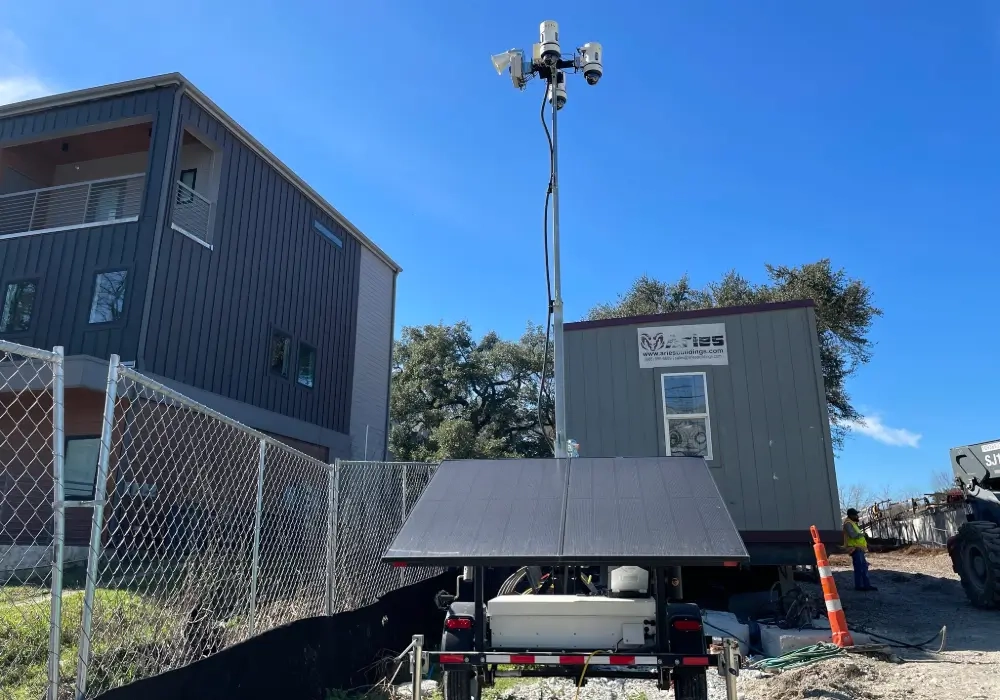
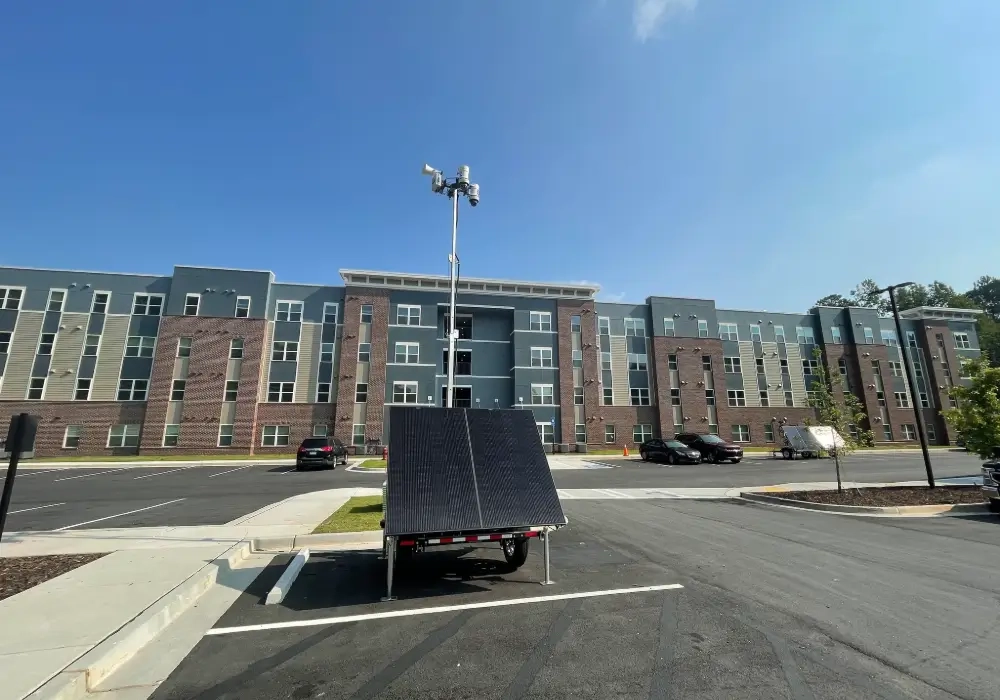
In contrast, a parking lot with visible active monitoring, like a LotGuard PRO Mobile Solar Surveillance Trailer, sends an entirely different message. Modern solutions like this signal that the area/site is being watched in real-time. In many cases, the presence of its telescopic mast with multiple cameras is enough to stop crime before it even starts.
Rapid Deployment Surveillance Specifically Designed for US Properties
LotGuard's mobile video surveillance units for surface lots mitigate, deter, and report theft, vandalism, and property damage, keeping your property, inventory, guests, and employees safe from day one.
Here's how these solutions are built to address the specific challenges facing commercial and vacant properties across the US:
-
LotGuard PRO: Designed to deliver rapid security coverage without requiring fixed power, Internet, or permanent infrastructure, this fully autonomous unit can be deployed to virtually any property in minutes. Standing up to 20-feet tall with multiple cameras that rotate nearly 360°, it provides wide-site visibility for parking lots, retail locations, and commercial properties.
-
LotGuard MINI: A compact PTZ (Pan-Tilt-Zoom) pole-mounted surveillance camera with AI detection, remote camera access, and optional live monitoring. Transmitting footage securely over cellular networks, live and recorded data can be accessed from any device.
-
License Plate Recognition (LPR) cameras: As add-on cameras to our Rapid Deployment units, LPR uses high-resolution imaging and onboard analytics to track all vehicle movement (including make, model, and color) in and around a property. By tracking suspicious vehicles, they help strengthen investigations while maintaining clear visibility across site access points.
-
Stellifii: Our cloud-based platform that connects every LotGuard system into a single integrated dashboard. Stellifi gives property managers/owners a convenient way to monitor, investigate incidents, and manage security across multiple locations, without being physically present.
Whether you're managing a commercial property portfolio, a residential community, or a vacant lot awaiting redevelopment, LotGuards surveillance solutions are designed to detect, deter, and defend properties against criminal activity.
Read more: Why Property Managers are Turning to LotGuard for Security
Protect Your Properties the Smart Way
While the national property crime trend is moving in the right direction, the risk is never zero for those managing high-exposure properties. Vacant buildings, empty after-hours commercial lots, and unsecured residential sites continue to attract unwanted attention.
Proactive mobile surveillance offers a smarter, more cost-effective way to protect your sites from property crime in the US. With advanced PTZ cameras, AI-video analytics, secure 4G/5G connectivity, and cloud-based monitoring, property management teams are better equipped to detect threats early and prevent incidents before they escalate.
What's more, effective parking lot surveillance significantly improves tenant safety and deters opportunistic crime, especially after hours.
Let LotGuard handle your security concerns while you focus on your day job. Contact our security specialists today for a free quotation.

Contents
[hide]Related news
Commonly Asked Security Questions From Property Managers
LotGuard answers the most common questions property managers ask about surveillance units and how LotGuard can help secure your properties. Read more

Nighttime: The Biggest Security Threat for Property Managers
70% of property crimes happen under the cover of darkness, when visibility is low, activity is minimal, and criminals believe they can act unnoticed. It’s in these hours—when your tenants, staff, and assets are most vulnerable—that security matters the most. Read more
Homeless Encampments and Property Security
Deploying LotGuard units on a property can help safeguard against various security and safety challenges from homeless encampments. Read more
Contact Us
Request a Quote for LotGuard
Ready to learn more about how LotGuard can protect your Parking Lots and Properties during the holidays? Get in touch today for a free quote.