
True Cost of Nighttime Vandalism for Big Box Retailers
Discover the real financial and operational impact of nighttime vandalism on big box retail sites, plus practical strategies to deter incidents and protect assets.
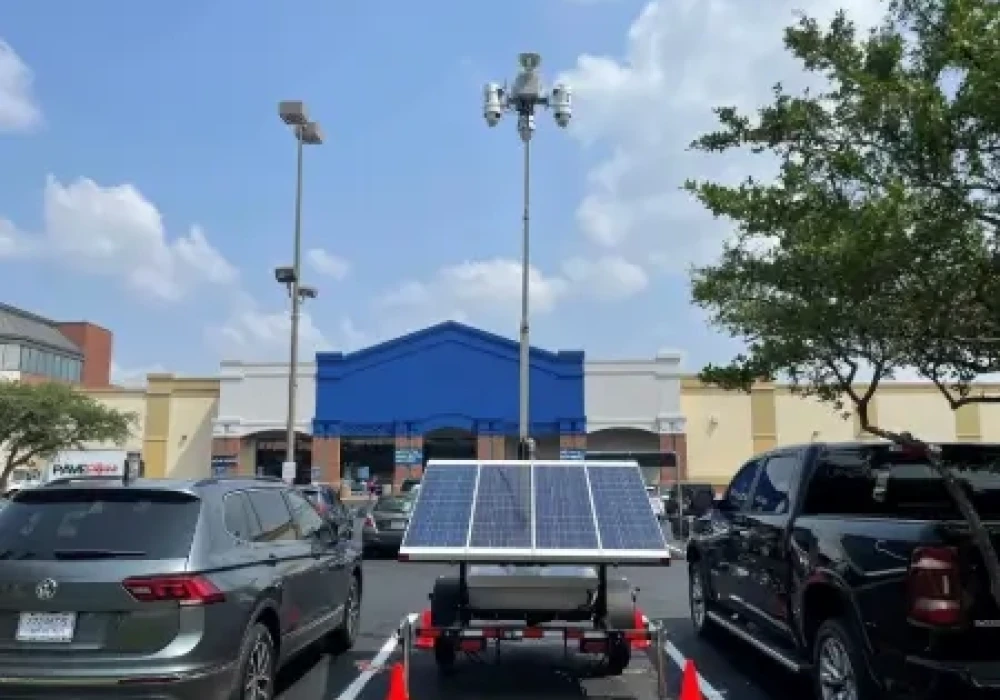
Nighttime vandalism isn’t just a nuisance, it’s a repeated, after hours loss that escalates quickly, especially for large scale retailers.
Often targeting the exterior areas like parking lots, overflow areas, and pedestrian walkways, vandalism tends to be an overlooked crime for retailers.
From repairs and rising insurance costs to customer claims and reputational damage, the real impact of nighttime vandalism is much broader and more expensive than most teams see from their incident reports.
We break down the true cost of exterior nighttime risks, and how proactive deterrence can save at scale.
The True Cost of After-Hours Vandalism
After hours vandalism rarely looks like a major incident when it appears as a consolidated incident at one store, however, across multiple stores, this is a completely different story.
With criminals mostly targeting retailers at night, when most are closed, damage can go unnoticed for hours, allowing for small incidents to escalate into large repairs, emergency support, and repeated high costs at the same locations.
Direct costs like broken fixtures, damaged carts, smashed windows, and graffiti removal are only one part of the bill. Many will not foresee the ripple effect which leads to further, indirect costs like overtime requirements, delayed openings, customers claims from parking lot incidents, and the unexpected rise of insurance.
Most importantly, vandalism is often pattern-based. Once criminals have recognized a location is neglected or underprotected overnight, one incident will quickly turn into several, driving ongoing costs instead of proactively preventing them on your sites.
For large scale retailers, it’s about zooming out from a singular incident and looking at your portfolio patterns. This way, you can see the scale of the issue more clearly.
Which brings us to a bigger question; how widespread is the issue of nighttime vandalism for big box and grocery retailers, and what does it typically look like for them?
The Real Scope of Vandalism for Big Box & Grocery Retailers
For big box and grocery operators, vandalism isn’t just a random attack, it’s location-driven, predictable, and often heavily concentrated in the exterior spaces and after dark.
The combination of a large, open parking lot, and multiple entry points creates long stretches of low-visibility perimeter for criminals to take advantage of. These factors make them attractive targets for both opportunistic damage and organized crime that may use vandalism as a cover for theft.
It can be easy to miss the true scope of vandalism, incidents are dispersed across hundreds of stores, generally handled by the local operations or facilities manager of that location.
Evidence recording will often be inconsistent, but when you map it portfolio-wide, clear patterns can emerge like store hotspot stores, geographies, and lot layouts that see repeat hits, and if these occur at similar time or at the same locations.
Vandalism covers a number of crimes, making it very difficult to police. Common nighttime targets and behaviors include:
-
Parking lot damage, including broken lights, damaged signage, and tampered gates.
-
Graffiti and tagging, from walls and dumpsters to storefronts and loading bays.
-
Entryways and facade incidents like smashed windows, broken kiosks, and vandalized displays.
-
Cart and store equipment sabotage, for example, damaged carts, pushed into vehicles, and destroyed pallet jacks.
-
Vehicle-related vandalism, from car break-ins, catalytic converter theft, or damage to fleet vehicles.
-
Loitering hotspots from groups congregating in blindspots. This can lead to littering, property and vehicle damage, and even theft.
-
Dumpster and back-of-house vandalism like fires, illegal dumping, or general destruction of loading bays.
Although vandalism can plague most industries, big box retailers and grocery stores are especially exposed:
-
High-traffic layouts and low overnight visibility make them more appealing once stores hit closing time and security lessens for most.
-
Multiple exterior assets which are often difficult to protect, such as carts, store signage, back-of-house equipment, and vehicles.
-
High likelihood of repeated vandalism and patterns of crime, especially once sites have been identified as easy targets after hours, leading them to become recurring targets, not just one-off incidents.
-
Overlap with other crime creating business loss like trespassing, vehicle break-ins, and exterior theft, making targeting crime more complex with prevention tools.
Overall, for big box retailers and grocery stores, vandalism isn’t just a crime that happens, it clusters in predictable places, times of days, and areas where deterrence is weak.
Once you’ve acknowledged the full scale of vandalism for your stores, the next step is to quantify what this crime is actually costing you. Starting with the direct costs, which will often show themselves first.
Direct Costs of Vandalism for Big Box Retailers
Direct costs are often the easiest to understand and spot because they show up quickly in invoices, work orders, and claims. However, even with a singular incident, the financial impact can add up quickly for your business, let alone when there are several.
We’ve broken down the core direct costs, big box and grocery retailers typically absorb:
| Direct Costs | What it Includes |
| Property Repair and Replacement |
|
| Graffiti and Cleanup Services |
|
| Parking Lot and Exterior Asset Damage |
|
| Vehicle-Related Costs |
|
| Operational Disruption with Immediate Financial Impact |
|
| Insurance and Claims Exposure |
|
The above only covers the direct costs, however, vandalism can cause much greater financial burdens that you may not even be aware of.
Indirect Costs of Vandalism for Big Box Retailers
Indirect costs are where most of the financial burden falls with vandalism, and where the long-term damage is often caused. This is because they don’t always show up immediately on an invoice, but rather, slowly damage revenue, labor stability, and risk exposure.
For the likes of big box retailers, these lesser known effects slowly compound themselves across locations and worsen over time. The most common indirect costs include:
| Indirect Costs | What it Includes |
| Customer Perception and Lost Trips |
|
| Brand and Community Reputation |
|
| Employee Safety, Morale, and Retention |
|
| Liability and Legal Exposure |
|
| Operational Loss across Loss Prevention and Ops |
|
| Escalation into Broader Crime |
|
Combining direct and indirect costs shows the true cost of nighttime vandalism, eliminating the old perception of it simply being a facilities headache. Recurring issues chip away at traffic, team stability, and brand confidence across all of your sites.
But even with these risks, many retailers will continue to allow the issue to escalate, trying to solve it with the same methods they have been using for years. The problem being that this method may work on some stores, but isn’t scalable across all stores.
Why Traditional Night Coverage Fails With Large Scale Businesses
Traditional systems may have been suitable for one or two stores, but these are not suitable for multi-site scalability. Big box retailers and grocery stores tend to be based across States, and fixed cameras or guards are both limited in their coverage and significantly expensive when scaled.
However, the high costs are not the only concerns, traditional systems are reactive, uneven, and inconsistent. This exposes stores to repeated vandalism attacks that quickly create costly losses for both the store itself and for the overall business.
The main problems with traditional systems are:
-
Reactive security - Incidents are often recognized after they’ve actually occurred causing store managers and the wider business in firefighting mode.
-
Gaps in security patrols - Due to patrol patterns, parking lots and exteriors are left unguarded and exposed to perimeter risks. They also tend to have predictable blind spots.
-
Costly to scale - Increased staff and overtime adds up quickly to security costs.
-
Inconsistent coverage across different regions - Different stores will face different risks, and these stores will vary with their protection meaning incident response is inconsistent and exposing some stores more than others.
-
Fragmented reporting - Multi-site security often runs over several systems when using traditional methods creating uneven data and misses trend information that would establish crime patterns.
-
No real-time visibility - For corporate loss prevention officers, managing multiple sites on traditional security methods means they’re unable to see overnight risks live, meaning incidents are often missed.
-
Individually treated fixes - Vandalism, trespass, and car crime are all treated separately, meaning managers and loss prevention officers can never get to the root cause of vandalism.
Traditional night coverage leaves too many gaps in surveillance, operations, financially, and in criminal deterrence. They may be able to manage one site, but they can’t establish patterns of vandalism or prevent crime across multiple stores.
Big box retailers and grocery stores must go smart with their security to ensure strong, consistent exterior protection of your sites, including parking lots. This means moving away from scattered systems and reactive responses to a modern, scalable solution built for the risks of nighttime vandalism.
The Modern Standards for Exterior Loss Prevention Protection
For large scale big box retailers and grocery stores, moving over to modern exterior loss prevention protection isn’t an option, it’s a necessity. Providing complete coverage that is consistent, proactive, measurable across every site.
We’ve created a practical checklist loss prevention leaders can use to evaluate whether a solution that is truly built for 24/7 coverage, most importantly overnight when vulnerabilities are most present:
1. Does it provide visible deterrence in the dark?
- Look for a solution with bold features that create a highly visible presence at night, displaying that your site is being monitored.
- Consider solutions made specifically for exterior areas like parking lots, entrances, and perimeter zones, as those will often be fitted with visible features aimed towards the particular risks linked to these location types.
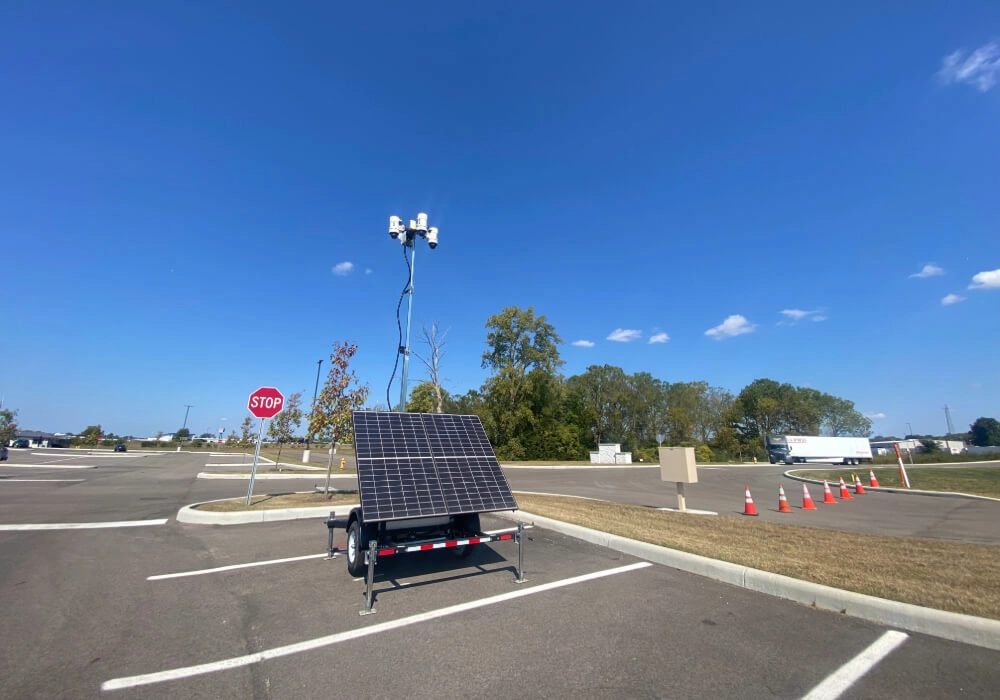
- Surveillance Trailers are a strong solution for parking lots and exterior areas, standing up to 20-feet tall and fitted with audio deterrence, they offer effective criminal deterrence.
2. Does the system offer real-time detection and intervention?
- Utilizes live remote monitoring and AI-video analytics to identify false alarms from suspicious activity like loitering, vehicle tampering, and trespassing onto site.
- Make sure any live monitoring is provided 24/7, especially at night when there are likely to be no staff present.
- Look for early intervention tools like live audio challenge features, lights, and remote operators to call law enforcement.
3. Can it provide full site and perimeter coverage?
- Ensure no blind spots are left uncovered by any security cameras.
- Check that any cameras are night-optimized through infrared and thermal technology, so detection is both clear and reliable.
- Think about all exterior areas, especially parking lots where there are high risks of loitering which can escalate quickly into more severe crime.
Learn More About Parking Lot Crime
4. Is the system able to provide centralized oversight of your stores?
- Corporate loss prevention leaders must consider every location, and how to monitor these without the need for multiple systems.
- Find a system that utilizes smart technology and allows for scalability with your store security. Software like Stellifii provides a centralized dashboard connecting surveillance footage, incident reports, and preventative tools for multiple stores in one place.
- Ensure that when scaling your system that it can provide standardized coverage for all locations, no matter the region or district budget differences.
5. Can it provide accurate reporting to ensure measurable data insights?
- A modern system should be able to provide consistent incident logs across all locations, documented response times, and resolution outcomes.
- Offers a centralized dashboard that can automatically create reports for trend reporting, helping to establish patterns by site, region, time window, and incident type.
- Provides easy export for operations, facilities, risk, and finance partners throughout the business.
6. Is the system able to provide ROI through loss prevention outcomes?
- Calculate your baseline incident rates before any surveillance deployments, and then measure the solution’s ‘after’ impact, keeping track of reduced incidents, reduced repeat crimes, and lessened guard hours.
- Make sure the system can provide clear, accurate evidence that can be used as proof of the system’ deterrence in preventing loss, not just recording footage.
7. Is the system cost-effective for your business and in scaling it across multiple stores with ease?
- Think about your needs both financially and operationally. Rental options may work best for exterior coverage and provide more flexibility with contracts.
- Look for pricing that is predictable and can be easily factored into your business’ expenses on a weekly, monthly, yearly basis.
- Look for a system that has portability as this allows for flexible, cost-effective deployment to store hotspots and for broader rollout.
8. Can the system manage multiple exterior risks?
- After hours crime extends from vandalism, trespassing, and loitering to vehicles break-ins, exterior theft, and smash-and-grabs, so check you have a versatile system prepared to manage all these risks.
- Aim to look for one solution that offers surveillance cameras, LPR technology, centralized oversight, and automated reporting in one, so you haven’t got to deploy a different system with its own platform for each issue or location.
9. Will the system save you operational burden?
- Avoid systems where loss prevention leaders and store managers will be left to babysit overnight security still
- Look for a solution that offers low-friction collaboration, providing teams with clear alerts and outcomes
- Ensure the system keeps loss prevention central to your strategy and not in cleaning up after an incident takes place.
This checklist of considerations allows you to establish the baseline for modern day standards of big box retailers and grocery stores, with the next steps being to see how a proactive, visible approach actually performs in a real-world setting.
Read More: What to Look For in a Parking Lot Surveillance Solution?
Proactive Deterrence in Action: How LotGuard Addresses Nighttime Risk
With nighttime vandalism commonly appearing in clusters throughout the exterior zones of your stores, like the parking lot, entrances, and loading bays, criminals will utilize the often low visibility and slow response to commit their crimes.
LotGuard’s parking lot surveillance solutions are designed to stop and interrupt that window of opportunity in real-time with both visible deterrence and proactive prevention techniques. With Stellifii’s support, this helps to standardize oversight and reporting across all store locations into one place, so that loss prevention leaders can view patterns, measure reduction, and scale easily.
Below outlines the various vandalism types that plagues big box retailers and grocery stores, and how LotGuard and Stellifii work together to prevent crime, reduce incidents, and scale easily across multiple sites:
| Vandalism / Exterior Risk | How LotGuard + Stellifii Prevent / Reduce It |
| General property damage (storefront, fixtures, perimeter assets) | Through LotGuard’s highly visibility mobile units, they help deter nighttime vandalism, while live monitoring catches activity early; Stellifii then aggregates incidents by site/region so repeat-hit stores are established quickly and standards are maintained consistently, portfolio-wide. |
| Graffiti and tagging | Visible overnight coverage shows criminals the store is being monitored and increases risks to taggers, helping to support quick intervention. Stellifii then tracks frequency and hotspots over time, proving reduction and helping target chronic issues and zones. |
| Parking lot loitering that leads to vandalism | Motion detection plus live voice-down warnings disperse groups before damage can occur or escalate. Stellifii centralizes alerts and outcomes so response is uniform across regions instead of store-by-store. |
| Nighttime incidents driven by low visibility | Infrared night cameras utilized by LotGuard’s solutions ensure reliable detection in poorly lit lots, whilst Stellifii provides a single dashboard for real-time after hours visibility and performance tracking. |
| Repeat vandalism at known “unguarded” sites | Persistent visible deterrence breaks repeat patterns and discourages return visits and Stellifii analytics show which sites are improving and where redeployment will produce the most impact. |
| Exterior risk overlap (vandalism, trespass, and theft) | LotGuard addresses the shared nighttime risk window in real time, deterring multiple behaviors at once through its visible deterrence, audio warnings, and remote monitoring features. Stellifii unifies reporting so loss prevention can manage these loss lanes together rather than in silos. |
| Costly reliance on overnight guards (reactive security) | Remote video monitoring reduces dependency on guards while improving coverage consistency, incident response, and criminal deterrence in-one. Meanwhile, Stellifii ensures enterprise scaling is manageable by overseeing many sites through one system that provides clear ROI reporting. |
Through proactive deterrence and real-time security monitoring, the focus transitions from paying for repeated damage caused by vandalism to displaying due diligence to your employees, customers, and business by proving that prevention is effective and scalable.
Read More:
Moving From Costly Reaction to Measurable Prevention With LotGuard
Big box retailers and grocery stores cannot afford to remain reactive in their response, and instead, must move to proactively prevent it by breaking the repeated cycle of incidents.
LotGuard delivers visible, real-time deterrence that stops incidents before they become a cost to your business. No longer will you be funding damage and fueling crime, but stopping it in its tracks.
And with Stellifii there to support reporting and consolidate security monitoring, loss prevention leaders are finally able to measure incident reduction, prove ROI, and scale systems with ease across multiple stores.
Start the journey to loss prevention and get in contact with LotGuard today to evaluate your high-risk sites, security needs, and scalability requirements!

Contents
[hide]Related news

A Rise in Retail Theft: How to Protect your Business Against This
A surge in retail theft has seen the number of incidents increase above that of the number reported in the same period before the COVID-19 pandemic. But what’s the reality of retail crime on businesses and communities? Find out below. Read more

The 8 Most Commonly Stolen Retail Products in the United States
Are you aware of what products are most at risk of theft in your store? Well, LotGuard has you covered as we reveal the 8 most commonly stolen retail products in the United States. Read more
How Parking Lot Security Cameras Improve Retail Customer Experience
Ensuring a positive customer experience is paramount for your business. Be sure to enhance it by securing your parking lots with LotGuard. Read more
Contact Us
Request a Quote for LotGuard
Ready to learn more about how LotGuard can protect your Parking Lots and Properties during the holidays? Get in touch today for a free quote.