
Environmental Risk Factors that Increase Property Crime Exposure
Property crime often comes down to opportunity. This guide explores the key environmental risk factors that make properties vulnerable, and how the right conditions can deter criminals before they act.

Most property crime is opportunistic. Criminals choose targets based on specific characteristics they spot right away, such as areas with poor lighting, no trace of surveillance, easy access points, and signs of neglect. When a property sends the wrong message, it becomes a soft target. When it sends the right one, criminals move on.
That's the idea behind environmental risk factors that increase property crime exposure in the US. The physical environment of a site, from its layout and lighting to occupancy levels, plays a major role in how attractive it looks to opportunistic offenders. For property management teams and commercial real estate investors overseeing multiple sites, those conditions are largely within your control.
That said, property crime can also be highly coordinated, involving organized crime groups that specifically target high-value assets and gaps in security repeatedly.
The real issue here is understanding why certain properties attract more crime than others, and what can be done to prevent it from happening in the first place.
This article covers everything you need to know about environmental factors, how criminal behavior compounds when multiple factors are in play, and how modern surveillance addresses the conditions thieves look for.
What is Property Crime Exposure and Why Do Environmental Factors Matter
Property crime exposure refers to how vulnerable a site is to criminal activities, such as burglary, larceny-theft, motor vehicle theft, vandalism, and trespassing. Safety concerns are based on the property's physical environment and situational conditions at any given time, and the idea behind situational crime prevention (SCP) explains why this matters so much.
Rather than focusing on offender characteristics (e.g., demographics), SCP focuses on the environment itself (e.g., neighborhood, natural surveillance, occupancy levels). Theory suggests that crime is more likely to occur when an opportunity arises, and that "fixing" the environment (i.e., removing the opportunity) can significantly lower urban crime.
Research findings support this view, whereby property crime in the US occurs every 3.9 seconds, making it one of the most common criminal offenses nationwide. Vacant properties are also 3 to 5X more likely to experience theft, vandalism, squatting, and homeless encampments compared to occupied buildings.
The Crime Prevention Through Environmental Design (CPTED) framework supports crime reduction through smarter site design and management. It's widely used in commercial and urban environments, structured around 4 key principles:
-
Natural surveillance
-
Territorial reinforcement
-
Natural access control
-
Maintenance
In practice, it means that a well-lit, clearly monitored, and well-maintained property signals that the site is active and looked after, and this naturally discourages opportunistic crime. When the risk of being noticed goes up, property and street crime tend to move elsewhere.
Understanding which key factors make residential and commercial properties vulnerable to crime is the first step toward changing them.
Read more:
6 Environmental Signals Criminals Look For
Here are the environmental factors that increase property crime exposure in the US, and ones that appear most consistently across commercial, vacant, and transitional property types:
1. Poor lighting
Around 70% of property crime happens in darkness, as it gives offenders cover to operate quickly and leave without being identified.
Poorly lit surface lots, stairwells, and perimeter edges are consistently flagged as high-risk zones, particularly at commercial and retail sites where activity drops off after hours.
Improved street lighting alone won't prevent crime, but without it, conditions worsen for almost every other risk factor on this list. Darkness is the one variable that amplifies everything else.
Read more: True Cost of Nighttime Vandalism for Big Box Retailers
2. Isolated locations
Properties in remote or low-traffic areas lack what environmental criminology calls "natural surveillance". This means there's very little "eyes and ears on the ground" from people just being present in the area.
A busy street has a lot more informal monitoring than a quiet road or an out-of-the-way parking lot. Fewer eyes means lower perceived risk to an offender, and slower response times if an incident does occur.
For commercial real estate investors managing transitional buildings, location isolation is one of the most difficult risks to address, and yet it's one of the strongest case studies for active tech-led monitoring solutions that can fill those surveillance gaps remotely.
Read more: Top Security Challenges for Property Managers and How to Overcome Them
3. Area demographics
As we've pointed out, the environment around your property matters.
Research shows that properties situated in areas with lower incomes, less neighborhood safety, and higher unemployment experience more crime. What's more, certain commercial sites, such as bars, drug treatment centers, liquor shops, and other less desirable facilities, also show higher crime rates.
Whether you own or manage residential, commercial, or transitional buildings, this isn't a reason to write off a property. It's a reason to invest in robust security that mitigates, deters, and prevents crime before it begins.
Read more: Commonly Asked Security Questions From Property Managers
4. Vacancy and visible signs of neglect
Property crime risk factors increase when occupancy levels are low.
Vacant buildings are 3 to 5X times more likely to experience theft, vandalism, and other property crime compared to occupied sites. With around 15 million vacant properties across the US, this is the harsh reality for property managers/owners responsible for vacant or transitional buildings.
Clear signs of neglect, such as overgrown gardens, uncollected mail, broken windows, litter and graffiti, and predictable vacancy patterns (e.g., weekends, evenings) are commonly associated with unoccupied lots and buildings.
Beyond traditional property crime, management teams also face threats such as copper theft, squatting, arson, illegal dumping, and homeless encampments.
Read more: Understanding How to Manage Vacant Properties in Texas
5. Lack of perimeter control
A property without boundary protection (fencing, access control) is more likely to attract suspicious behavior than properties that have it. Having many unsecured access points and a lack of visible security deterrents makes unauthorized access easier for criminals.
While proper perimeter security for large commercial and industrial sites can be complex, having limited staff outside business hours creates the exact gaps that criminals look for and exploit.
Read more: The Importance of Perimeter Security for Commercial and Industrial Properties
6. Construction activity
Active jobsites are filled with high-value assets, equipment, building materials, and copper wiring that quickly sells on illicit markets. Combine that with limited nighttime security and open perimeters, and property crime increases tenfold across commercial and industrial sites.
With more than 1,000 construction equipment thefts reported each month, relying on passive security isn't enough. Whether you're developing a residential block or revamping an office park, these conditions give criminals the "green light" to strike without fear of being noticed.
Read more: Protecting Your Property From Metal Theft This Winter
How Environmental Factors Increase Property Crime Exposure
No single environmental risk factor creates serious vulnerability on its own. The real risk comes when several factors stack up at once. When that happens, a property’s exposure to crime increases quickly.
For example, a vacant building in an isolated location is more exposed than a vacant building on a busy street. Add poor lighting, no visible surveillance, and signs of neglect, and you've created a site that actively invites illicit human activity. Add predictable vacancy patterns and a lack of perimeter control, and the risk compounds further still.
Property managers overseeing portfolios of commercial, vacant, or transitional assets need to think about risk in terms of "combinations", not individual factors. A property might score well on perimeter control but poorly on lighting and occupancy, and that combination may be enough to increase exposure.
Passive Security vs Monitored Mobile Surveillance
So, how do you reduce property crime exposure in the US? Many property managers default to basic security solutions such as fixed cameras and occasional guard patrols, but don't consider their limitations.
Passive security addresses some of those factors, but it doesn't actively prevent crime from happening.
| Factor | Passive surveillance | Smart surveillance |
| Crime deterrence | Limited | High |
| Deployment speed | Slow | Rapid |
| Response times | Delayed | Near-instant |
| Connectivity | Requires fixed infrastructure | Solar; 4G/5G technology |
| Coverage | Limited, fixed | Near-360° |
| Relocatable | No | Fully repositionable |
| Cost | High | Cost-effective rentals |
The environmental conditions of a property communicate its risk level to potential intruders before they've even approached it.
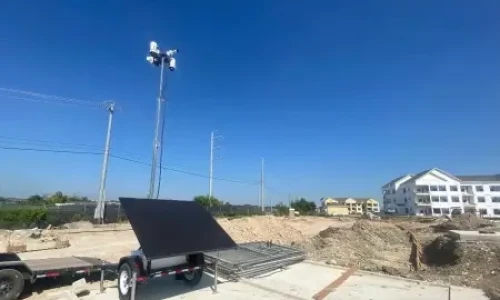
For instance, a parking lot with a visible LotGuard PRO Mobile Solar Surveillance Trailer signals active monitoring, active presence, and active response. Therefore, changing what your property communicates is the foundation of effective crime prevention.
Addressing Environmental Risk with Rapid Deployment Surveillance
LotGuard's mobile video surveillance units protect surface lots by deterring and detecting criminal activity before it causes damage. This helps keep your property, assets, and employees safe.
Here's how our solutions directly counteract the environmental risk factors that make properties a target:
-
LotGuard PRO: A fully autonomous solar surveillance solution that can be deployed to any property's lot in minutes with no fixed power or mounting infrastructure. Its 20-foot tower with integrated blue lights, sirens, and live audio voice-down capability directly addresses the 2 most prevalent environmental risks: lack of visible surveillance and absence of active presence.
-
LotGuard MINI: A compact, rapid-deployment pole camera delivering 4 independent video streams from a single unit. Ideal for targeting specific high-risk points where environmental vulnerabilities are most concentrated.
-
License Plate Recognition (LPR) cameras: Automatically logs every vehicle entering and exiting your property, building a timestamped record that supports law enforcement investigations and insurance claims.
-
Live Monitoring: Trained security professionals monitor AI-triggered alerts from your LotGuard units in real-time. When a threat is verified, they can trigger deterrents, issue live audio challenges, and dispatch law enforcement, enabling faster intervention and response compared to passive systems.
-
Stellifii: Our cloud-based platform connects every LotGuard unit across your portfolio into a single management dashboard. This gives property managers and investors real-time visibility across multiple sites without the requirement to be physically present at any of them.
Recognize Environmental Risk Before It Becomes a Problem
Environmental factors that increase property crime exposure rarely happen overnight. They develop gradually and are often visible long before an incident ever occurs. Issues like poor lighting, overgrown landscaping, signs of neglect, and long vacancy periods create exactly the conditions criminals look for when choosing their next target.
Removing these risk factors with modern mobile monitoring can make a big difference. When you remove the red flags, you remove the opportunity for crime.
LotGuard's systems are "Always Awake and Always on Guard", giving you the visibility and rapid response to stay ahead of risk rather than react to it. Contact our surveillance specialists today.

Contents
[hide]Related news

The State of Property Crime in the US (And How to Protect Yours)
Explore the current state of property crime in the US and learn how smarter security solutions can help protect your property. Read more
Commonly Asked Security Questions From Property Managers
LotGuard answers the most common questions property managers ask about surveillance units and how LotGuard can help secure your properties. Read more

Nighttime: The Biggest Security Threat for Property Managers
70% of property crimes happen under the cover of darkness, when visibility is low, activity is minimal, and criminals believe they can act unnoticed. It’s in these hours—when your tenants, staff, and assets are most vulnerable—that security matters the most. Read more
Contact Us
Request a Quote for LotGuard
Ready to learn more about how LotGuard can protect your Parking Lots and Properties during the holidays? Get in touch today for a free quote.