
Mobile Surveillance: The Modern Alternative to Guards for Franchise Businesses
Learn how mobile surveillance improves parking lot security for franchise businesses without relying on on-site guards.
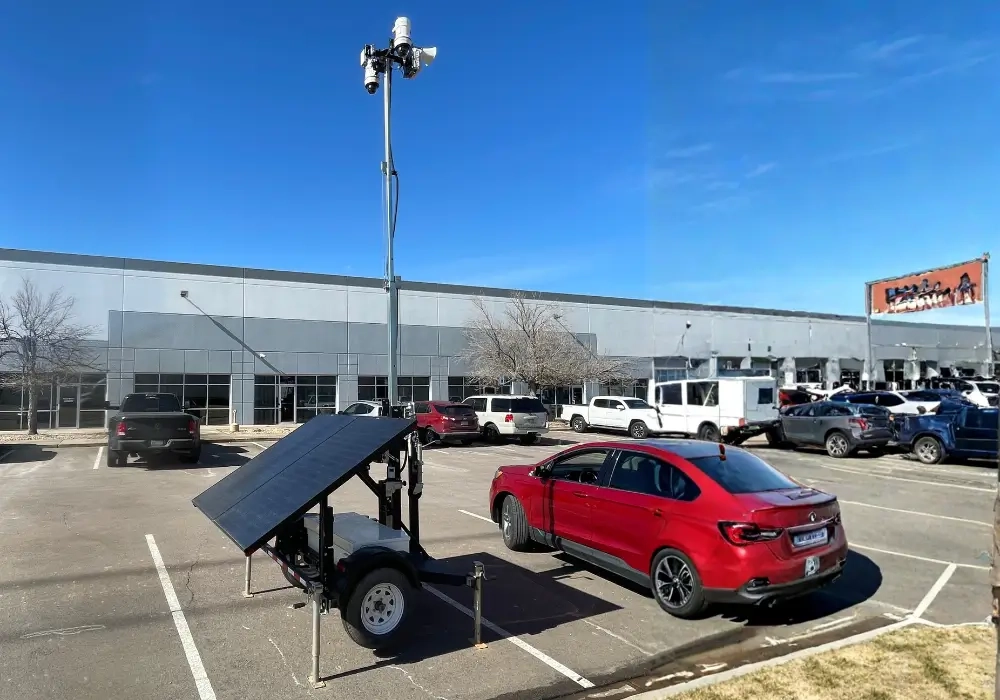
For franchise owners managing multiple stores across various locations, security is not just about protecting one high-crime store, it’s about protecting brand reputation, enhancing employee safety, and reducing costs throughout your sites.
However, parking lots, external property, and EV charging stations are often overlooked areas of concern, even though they are common entry points to crime such as loitering, theft, and vehicle damage.
As a result, many franchise leaders are considering their options, reevaluating whether security guards or mobile surveillance is the smarter solution for their business and supports scalability.
The Real Security Challenge Facing Franchise Businesses Today
Security isn’t just a single-location decision for multi-site franchise owners, it’s a network-wide responsibility that effects every storefront, charging station, parking lot, and nightshift employee.
Stores facing repeated loitering and crime creates larger issues when it comes to franchise businesses, placing risks around brand trust, employee confidence, and multi-site profitability.
Retail stores often operate in easily accessible, highly visible locations, with most operating after hours to increase profits. Although this combination of open access and high-traffic customer business creates an opportunity for increased revenue, it creates even greater opportunity for unwanted activity.
Incidents rarely stay isolated, they create a ripple effect that impacts a whole brand, not just a singular store. Just one vandalized car in a parking lot at your store can influence customers’ perceptions across that entire region, even the brand as a whole.
Security challenges may appear obvious, however, there are several challenges for franchise stores that come across small but can quickly escalate into much more. We’ve broken down the most common security challenges franchise stores face and their related risks:
| Security Challenge | What It Looks Like in Franchise Retail | Risk to the Business |
| Late-Night Loitering | Groups gathering at storefronts, in parking lot, EV charging stations, and delivery areas after hours | Customer safety concerns, fewer nighttime sales, and increased risk of theft and vandalism |
| Property Vandalism | Damaging external property through graffiti, braking signage, and destroying lighting, EV cables, and delivery equipment | High repair costs, increased insurance claims, reputational damage, and loss of revenue during any repairs |
| Resource Stretched Overnight Staffing | Minimal staff managing the entire store, both internal and external matters | Employee safety concerns, increased vulnerability, and greater liability exposure to insurance claims |
| Inconsistent Security Coverage | Traditional offerings like fixed surveillance and security guards offer limited coverage or use varying standards across sites | Uneven protection, increased reporting gaps, and compliance risks that create liability exposure and regulatory scrutiny |
| Rising Labor Costs for Security Guards | Increased wage and overtime rates, holiday and sick pay, high turnover, higher training costs, and inconsistent reporting | Tight operating margins, expensive to scale across multiple sites, and increased risk of missed crime |
| Reactive Incident Response | Security offerings only provide footage for review after an incident has occurred | Unnecessary losses, repeat incidents, and higher long-term costs for record-only functions |
| Poor Multi-Site Visibility | No centralized reporting or site visibility across all store locations, often providing singular site security | Delayed incident response, limited accountability, and limited to no capability to identify patterns or trends |
To understand the current security gaps franchises commonly fall victim to, it’s important to understand the role security guards traditionally have played and where they’re now missing the mark.
Traditional Security Guards: Strengths, Limits, and Hidden Costs
Security guards have often been considered an effective option for site surveillance over the last few decades, and even today, continues to be a familiar method used by many franchise stores.
Their physical presence and official uniform aim to provide strong visible deterrence, following scheduled patrols that rely on their human judgement to respond to incidents that arise outside of stores. Whilst also delivering reassurance to staff and customers regarding their safety.
However, for multi-location franchise stores operating long nights with minimal staffing, security guards as a model offer strengths, limitations, and hidden costs all managers need to be aware of.
The Strengths of Security Guards
Security guards offer multiple benefits to franchise businesses today, including:
-
Visible deterrence that discourages opportunistic theft and loitering
-
Immediate on-site response from guards to crime in real time or who can contact authorities
-
Customer reassurance by providing overnight presence where they are likely to feel more vulnerable
-
Access control support as guards can manage entry/exit points, check employee credentials, and monitor suspicious behavior
The Limitations of Security Guards for Franchise Businesses
Although guards still hold their benefits, the growing demands of franchise stores mean that there are several operational limitations with them:
-
Scheduled patrols make them predictable to criminals, increasing the risk of missed incidents and providing inconsistent surveillance
-
Intermittent visibility means guards can be ineffective in deterring crime unless they are present as the incident is taking place
-
Inconsistent quality due to varying security standards and training, leading to differing patrols and responses that continue to leave stores at risk
-
Limited coverage as guards are unable to continuously monitor large exterior spaces like parking lots and EV charging stations
-
Reactive incident response, with many incidents only being addressed after they begin rather that working to prevent them in the first place
-
Limited security capabilities due to safety rules imposed on guards meaning they can only provide minimal intervention without law enforcement support
The Hidden Costs of Security Guards
Contracts often appear transparent, however, security guards often come with hidden costs that extend beyond their hourly rate:
-
Rising labor expenses due to overtime, holiday pay, overnight increases, and sick pay
-
High turnover and training leads to inconsistent service and expensive onboarding costs, which are often repeated
-
Vendor management complexities surrounding different guard providers and managing these across various store, creating expensive admin time
-
Liability exposure due to inconsistent incident response, reporting, and escalation processes that create legal and insurance risks
-
Scalability limitations created through store expansion and renegotiating contracts, commonly linked to added labor costs for additional guards
For franchise managers looking for multi-site protection, consistency is key. Hence why many are now turning towards technology-driven approaches that transition security from reactive response to proactive prevention.
What Is Mobile Surveillance
Mobile surveillance is technology-led security that is quick-to-deploy, provides flexible coverage, and easy-to-scale. Designed specifically to protect large exterior locations like retail stores and restaurants, including their parking lots, providing a reliant, cost-effective surveillance alternative to guards.
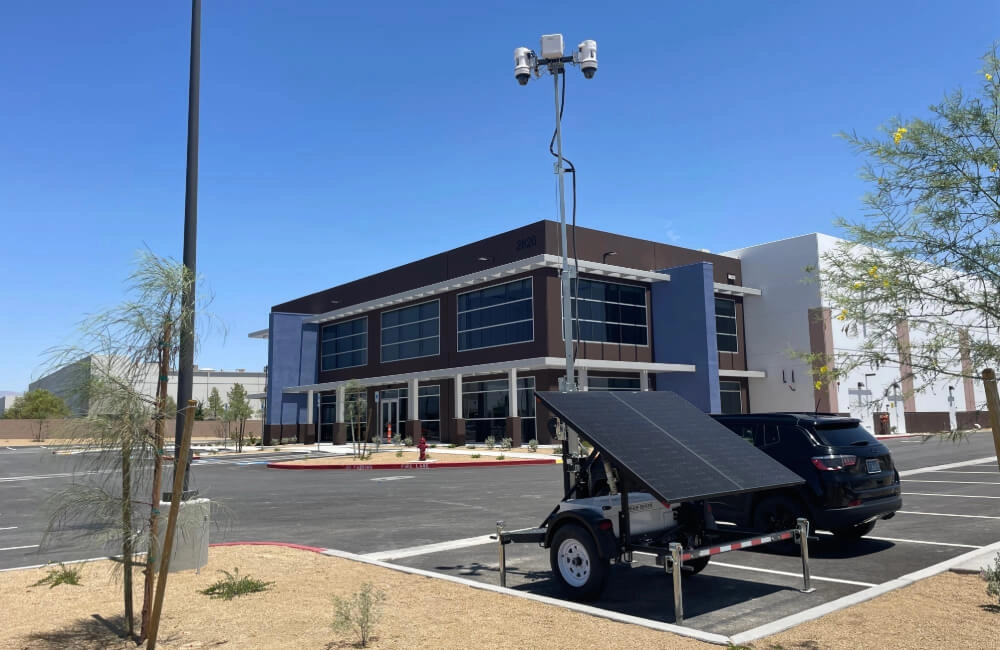
From surveillance trailers to pole/dome cameras, these systems combine high-quality cameras, elevated visibility, advanced nighttime coverage, and live remote monitoring to deter crime and offer real-time incident response.
Compared to traditional, fixed surveillance systems that generally offer limited coverage and record-only functionality, mobile surveillance solutions provide proactive, continuous store oversight capable of covering parking lots, entrances, and high-risk exterior areas.
These systems are often easily relocatable, and advanced systems offer even more, providing additional features that allow managers to scale their systems across multiple sites, connecting live and recorded video feeds throughout all locations into one centralized platform like Stellifii.
Why Franchises Are Adopting Mobile Surveillance
One of the biggest challenges of franchise managers is the difficulties surrounding system scalability and aligning this with the realities of their stores. Mobile surveillance offers a solution that resolves these complexities without the need for fixed infrastructure or high costs:
-
Scalable Protection Across Multiple Store Locations – Mobile surveillance is easily standardized across large regions. Instead of negotiating additional guards for each store, franchise managers can easily scale their systems to gain consistent coverage, reporting, and site visibility.
-
Predictable Costs – Security guards are labor-based models that fluctuate with wages, overtimes, holiday, sickness, and nighttime fee increases. Mobile surveillance replaces this model with a more stable rental agreement, helping to keep costs predictable.
-
Stronger Criminal Deterrence – Surveillance trailers with elevated camera masts offer strong visible deterrence backed by proactive remote monitoring and video analytics to help minimize crime like theft, vandalism, and late-night loitering.
-
Increased Security Coverage Without the Need for Additional Workers – Franchise stores tend to operate with minimal staff, especially after hours. Mobile surveillance provides live video monitoring and real-time response to provide enhanced reassurance and protection to employees, particularly lone workers.
-
Centralized Visibility and Reporting – Franchise managers look after several stores, and mobile surveillance can be used to support multi-store security, providing centralized visibility and incident reporting.
-
Operational Flexibility – Risks are never fixed; they move across sites and create crime hotspots where stores lack security. Mobile surveillance provides managers with increased coverage that can be deployed across stores with ease.
Having now defined both approaches, the next step is to evaluate the differences between mobile surveillance and security guards to support franchise managers in making well-informed, data-backed decisions surrounding their security.
Mobile Surveillance vs Security Guards for Franchises: A Side-by-Side Comparison
Overseeing multiple store location is a daily challenge for franchise leaders where security is based on outcomes. They require consistency, cost predictability, and extended oversight capable of managing the external risks presented to their stores.
Outlined below is a direct comparison of mobile surveillance vs. security guards for franchises, and how they support them where it matters most.
| Evaluation Factor | Security Guards | Mobile Surveillance |
| Surveillance Coverage | Limited coverage due to scheduled patrols that provide intermittent visibility | Continuous, reliable monitoring across large spaces like parking lots and storefronts |
| Criminal Deterrence | Only effective when present, meaning impact varies based on performance and consistency | Provides highly visible 24/7 presence through elevated cameras and bold design |
| Site Scalability | Requires additional security to be employed to manage further sites | Easily relocatable across various sites or quickly deploy additional systems elsewhere whilst remaining cost-effective |
| Cost Structure | Costly hourly labor, overtime, holiday, sickness, and turnover expenses | Predictable monthly costs with reduced labor dependency |
| Performance Consistency | Varies across providers, guards, and shifts | Standardized monitoring, reporting, and response procedures across all sites |
| Response Model | Primarily reactive incident response, only possible when they are present at the scene | Proactive alerts with real-time monitoring and crime intervention |
| Multi-Site Visibility | Requires manual coordination and local supervision, leaving managers without the capability of centralized oversight across multiple sites | Centralized reporting and visibility offered within the platform of all locations, providing managers with remote access to view live and recorded footage |
| Flexibility | Limited or fixed due to patrol schedules and contract terms | Relocatable units and easily scalable technology that offers managers complete flexibility |
The benefits of mobile surveillance can only truly be understood when considered in the day-to-day operations of franchise leaders and how they can address specific challenges faced by stores.
How Mobile Surveillance Solves Common Franchise Pain Points
For franchise managers, security issues show up in financial loss, from repair/replacement costs and insurance claims to high employee turnover and lost customer revenue.
Simply responding to incidents isn’t enough, it’s about preventing them whilst also maintaining consistent standards across all your stores. By adopting mobile surveillance, there are several challenges they address in a practical, scalable manner:
-
Reduce late-night loitering – Visible mobile units like surveillance trailers backed by live video monitoring help deter unwanted activity, specifically late-night loitering in parking lots, EV charging stations, and delivery areas. Real-time audio warnings help deter and prevent incidents before they can escalate.
-
Prevents vandalism and property damage – Mobile surveillance provides continuous monitoring and instant alerts to ensure incidents are addressed in the moment, not after they happened. In turn, this reduces repair costs, operational downtime, and protects brand reputation.
-
Supports resource-stretched overnight staffing – Live remote monitoring provides an added layer of protection to overnight employees and lone workers, helping to provide reassurance and improve safety during their shifts.
-
Creates consistent multi-store visibility – Provides centralized reporting and standardized monitoring across all locations, giving managers complete visibility and trend tracking, helping them to allocate resources.
-
Improves cost control – Guards are costly and mobile surveillance offers a more predictable, cost-effective rental model that can be scaled with ease, without dramatically increasing costs.
When you measure these operational benefits against the long-term performance and cost efficiency of mobile surveillance, the financial case for them only strengthens further.
Read More: Five Ways Mobile Surveillance Cameras Improve Safety Across Multiple Store Locations
Proving ROI: Why Franchise Leaders Are Rethinking Guard-Only Models
With any security decision, return on investment plays a key factor in whether a franchise manager will adopt the system for their sites. Although this isn’t the only important element in decision-making, it’s a vital part of maintaining security and keeping costs suitable for scalability.
Guard-only models appear simple from the outset, however, when you try to scale this method across multiple stores and overnight coverage, the financial impact becomes more complex and costly.
Due to this, franchise managers are often left questioning the cost structure and scalability of guards vs. mobile surveillance, and which is solution is best for them.
| Cost Factor | Security Guards (Overnight Coverage) | Mobile Surveillance |
| Monthly Cost (Per Location) | 1 guard x 8 hours/night x 30 days x hourly rate | Predictable monthly cost, often including monitoring and maintenance fees |
| Overtime/Holiday Premiums | Additional costs, especially during peak periods | Provide 24/7 monitoring without any additional overtime or holiday fees |
| Turnover and Training | High turnover leading to frequent onboarding and retraining to align with security standards | Not labor dependent, often automatically updating software and providing built-in performance monitoring |
| Multi-Site Scaling | Multiply labor costs per additional store | Standardized deployment model, offering both relocation or additional systems across sites |
| Administrative Oversight | Vendor management, scheduling, payroll coordination | Centralized reporting, monitoring, and compliance management. Commonly offering additional integration of LPR that all feed into one platform |
| Incident-Related Losses | Reactive response, following an incident where damage is likely to have already occurred | Proactive deterrence that prevents crime from taking place or escalating |
| Redeployment Flexibility | Requires contract adjustments or additional employment | Relocatable units across sites, or option to scale through additional systems with a quick turnaround |
For franchise managers, it’s about weighing up the key factors involved in effective security, including performance, scalability, and long-term cost control.
The Future of Franchise Security Is Proactive, Visible, and Mobile
For franchise stores, the greatest vulnerabilities often lie in the external areas like storefronts, parking lots, EV charging stations, and delivery areas. Hence the need to prioritize surveillance for those locations.
The future of any franchise business is centered around protecting the external environment, where most unwanted activity begins, in aims of preventing incidents before they can even take place.
Solutions like LotGuard are built specifically with this in mind, protecting parking lots, EV charging stations, and exterior property from crime. Delivering high visibility criminal deterrence through its presence, and backed by live monitoring and video analytics, they provide real-time intervention, proactive support, and evidential footage.
Instead of waiting to respond after vandalism, loitering, or theft has happened, our parking lot surveillance solutions help deter unwanted activity from the get-go before impacting your business.
LotGuard supports modern franchise operations by providing:
-
Continuous oversight of large exterior areas, even at night
-
A strong visual deterrent that discourages loitering and vandalism
-
Real-time response capabilities that reduce escalation
-
The flexibility to relocate units between sites or scale systems as risk patterns change
-
Connect site management, reporting, and vehicle monitoring into one platform through the power of Stellifii
For multi-store operators, external security can no longer be overlooked. In fact, it’s a critical part of maintaining brand trust, enhancing employee safety, reassuring customers, and building strong community relationships.
With security guard shortages and labor cost strains, the most effective security strategies incorporate visibility, proactive prevention, and mobility. LotGuards’ solutions provide exactly that, helping franchise managers meet their operational goals through scalable, technology-driven protection designed for modern retail environments.
Ready to strengthen security across your franchise locations? Contact our team today to schedule a consultation and see how flexible, visible protection can reduce risk while improving operational efficiency.

Contents
[hide]Related news
How Parking Lot Security Cameras Improve Retail Customer Experience
Ensuring a positive customer experience is paramount for your business. Be sure to enhance it by securing your parking lots with LotGuard. Read more

The 8 Most Commonly Stolen Retail Products in the United States
Are you aware of what products are most at risk of theft in your store? Well, LotGuard has you covered as we reveal the 8 most commonly stolen retail products in the United States. Read more
The Hidden Costs of Late-Night Loitering in Fast Food Restaurant and Retail Parking Lots
Explore the hidden costs of late-night loitering in fast food and retail parking lots, including safety risks, liability, and operational impact. Read more
Contact Us
Request a Quote for LotGuard
Ready to learn more about how LotGuard can protect your Parking Lots and Properties during the holidays? Get in touch today for a free quote.